

Two Worlds, One King: Palace Bridges Gap Between Ancient Norms And Modern Reality
- Par Kimeng Hilton
- 22 Jan 2026 18:23
- 0 Likes
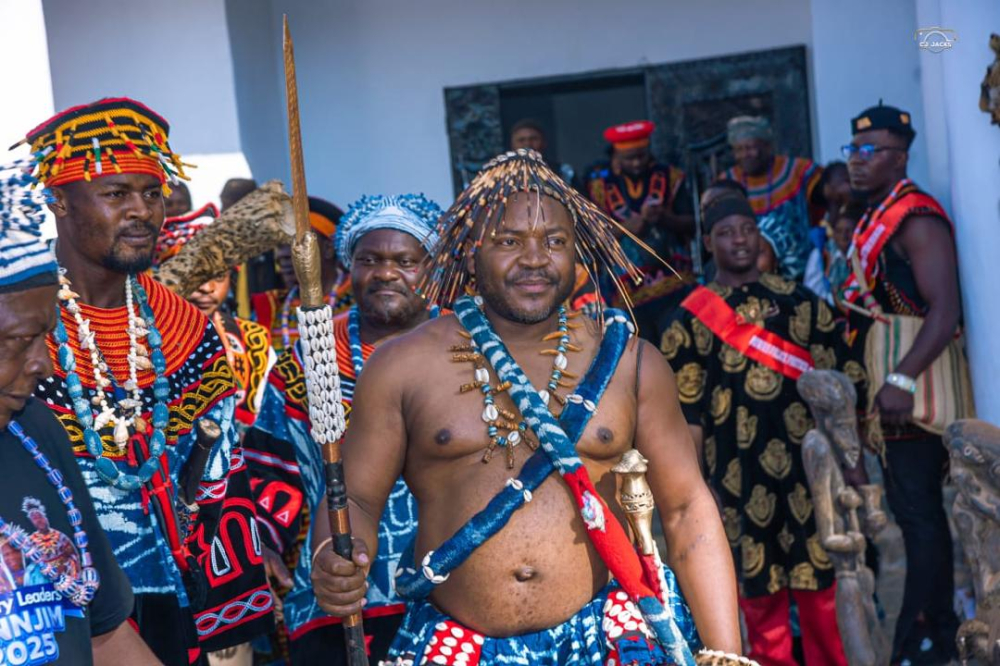
King Muluh Taka IV of Muwah in Pinyin Clan of the North West Region has his sights set on greater heights for his subjects. With his recent choices and decisions being groundbreaking.
The rain in Yaounde falls with a heavy, rhythmic persistence, washing the red dust from the streets of the Damase neighbourhood. It is Tuesday, January 20, 2026, and inside the stately home of Mrs. Mary Taka Tanni, a retired senior journalist, the air is thick with the weight of history and the scent of royalty. Outside, the city bustles with the chaotic energy of a capital in transition. But inside, a quieter, more profound transformation is taking place.
Pivotal, Historical Moment
His Majesty King Muluh Taka IV, the Fon of Muwah in the Pinyin Clan of the North West Region, sits regally. His demeanor a blend of the corporate composure he has honed as a banker in South Africa. And the grounded gravity of an African traditional ruler. He is in Yaounde on a brief stopover, pausing on his long journey back from his ancestral home to his professional base in South Africa. But this is no mere layover; it is a pivotal moment in the history of his people.
New Servants Of The Palace
Surrounded by elders, royals, and dignitaries, the King sits on his throne. He is here, amongst others, to elevate two women to the highest echelons of traditional authority. A move that sends shockwaves through the conservative veins of the Grassfields culture. As he bestows the title of Ma’ah Nyingfor wa Muwah upon his host, Mrs. Mary Taka Tanni, and Ma’a Pifor wa Muwah upon Mrs. Justine Tamumgang. He declares them not just servants of the palace, but "Mothers of the King" and "Pillars of Royal Authority."
It is a radical act of inclusion, but it is only the climax of a story that began weeks earlier, a story of return, reconciliation, and a remarkable triumph of peace over chaos.
The Silent Decade
To understand the magnitude of this moment, one must understand the silence that preceded it. For six years, the throne of Muwah was occupied in spirit, but vacant in physical presence. Fon Muluh Taka IV had become King in 2019, ascending to the revered seat of his forefathers. Yet, fate - and the brutal realities of the Anglophone Crisis - conspired to keep him away.
The North West and South West Regions of Cameroon have been gripped by an armed conflict that has torn the social fabric of the nation. For a traditional ruler, whose authority is rooted in the soil he treads and the people he touches, ruling from abroad was an agonizing paradox. From the high-rise offices of South Africa, where he works as a banker, the King watched from a distance. There were rites to be performed, disputes to be settled, and ancestors to be consulted, all of which required his physical presence.
"There was a big problem, particularly as a traditional ruler," the King would later reflect, his voice carrying the weight of those lost years. "There were ceremonies, rites and a number of significant cultural activities my subjects could not perform in my absence."
Cultural Drought
The absence was not merely a physical one; it was a cultural drought. The palace stood as a symbol of a stalled timeline. The community could not install family successors; they could not perform the blessings that tether the living to the dead. The village of Muwah, like many others in the conflict zone, was caught in a suffocating stasis.
But the desire to return never faded. It burned quietly, nurtured by phone calls, updates from trusted aides, and an unshakeable sense of duty. As the security situation began to show tentative signs of improvement, the King made a bold decision. He would leave the safety of South Africa and return to the heart of the conflict to reclaim his crown and, hopefully, revive his kingdom.
The Homecoming
The journey back to Muwah was not just a commute; it was a pilgrimage. When the Fon’s convoy finally rolled into the village, the atmosphere was electric. It was December 20, 2025, a date that would instantly be etched into the oral history of the clan.
Though he had been King for six years, this was the day of his formal enthronement. The delay in the ceremony did not diminish its potency; rather, it concentrated it. The anticipation had built up for a decade, and when the day finally arrived, the relief was palpable. "It felt very relieving," the King recalls. "Having stayed away from home because of insecurity for a very long time... the return was a release."
Mannjim Festival
The landscape of the North West is breathtakingly beautiful, a rolling tapestry of green hills and lush valleys, but it has been scarred by violence. Yet, as the King stepped onto the sacred ground of his palace, the scars seemed to momentarily fade. The air was filled with the sounds of jubilation - drums beating in complex rhythms, women ululating in high-pitched trills, and the roar of a crowd that had waited far too long to see their monarch.
This joyous arrival marked the beginning of the Mannjim Festival, a two-week cultural extravaganza that would double as a celebration of the King’s enthronement. The festival, running from December 20, 2025 to January 4, 2026, was ambitious in its scope. It was not merely a display of culture; it was a statement of resilience.
A Symphony Of Culture
The Mannjim Festival was a masterpiece of organization and spirit. In a region often defined by the headlines of conflict, Muwah chose to define itself by the headlines of culture. For 16 days, the kingdom was alive. "Mannjim was very successful from the first day... until the end," the King says, a rare pride evident in his tone. "Why do I say so? Because both pictures and videos from the event attest to how successful it was."
The success was not accidental. It was the result of meticulous planning and a collective yearning for normalcy. The festival drew a cross-section of society that mirrored the Cameroon the King hoped to see. Muwah people turned out in their thousands, dressed in their finest regalia. Neighbours from Santa Subdivision arrived in droves. Administrative authorities and security forces were present, not as enforcers of order, but as participants in the celebration. "We wanted to show that peace is possible," the King emphasized. "And indeed, the event ran continuously for two weeks without an incident."
Balance Of Ancient, Modern
The programme was a delicate balance of the ancient and the modern. There were traditional dances, each step telling a story of the ancestors. There were rites of passage performed in the dead of night, known only to the initiated. But there was also a football peace tournament - designed to engage the youth and channel their energy into something constructive.
The playground buzzed with excitement as young men from rival villages competed not on the battlefield, but on the pitch. It was a powerful metaphor: the conflicts that usually divide them were set aside for the love of the game. The tournament was more than sport; it was a ritual of reintegration, a way to heal the trauma of a generation that had grown up knowing nothing but instability.
“Nifanghe La'ah” - The Day of Reconciliation
While the football tournament and the dances provided the soundtrack to the festival, the true heart of Mannjim beat strongest on January 1, 2026. This day was known as "Nifanghe La'ah" - the Day of Reconciliation and the Promotion of Peace. In the Grassfields tradition, the land and the people are inextricably linked. Years of bloodshed and strife are believed to contaminate the soil, cursing the harvest and poisoning the community. Nifanghe La'ah was the spiritual detox the kingdom desperately needed.
"It was a day to forgive one another, and a day to bless the land," the King explains. The rituals performed on this day were ancient and visceral. Libations were poured. Elders spoke words of absolution. Grievances that had festered in the silence of the conflict were brought into the light and discarded.
As Guests Poured In
The impact of Nifanghe La'ah extended beyond the spiritual realm into the practical. Following the cleansing, the palace opened its gates to receive delegations. In all, seven delegations from neighbouring villages in the North West and West Regions arrived at the Muwah Palace. They came with their Fons, their dancers, and their gifts.
Each village was given a day to showcase their culture. The palace grounds became a kaleidoscope of colour, as different dance troupes gyrated to the rhythm of the talking drums. They brought food, drinks, and cows - symbols of prosperity and brotherhood. The slaughtering of these cows and the sharing of the meal was the ultimate seal of peace. In Africa, to eat from the same bowl is to dissolve enmity.
Thirty-Year-old Animosity Ends
Perhaps the most significant diplomatic achievement of the Mannjim Festival was the resolution of a conflict that had plagued the region for three decades. Muwah and its neighbor, Buchi village - both part of the Pinyin Clan - had been at loggerheads for 30 years.
The roots of the feud were buried deep in the past, a tangled mix of chieftaincy and family disputes, misunderstandings, and inherited grudges. For 30 years, the relationship was defined by tension, silent hostility, and occasional violence. The King knew that for his kingdom to truly thrive, this specter of the past had to be exorcised.
"We met in the Divisional Officer’s office in Santa and negotiated peace," the King recounts. The setting was significant. It was a neutral ground, under the auspices of the State administration, signaling a return to the rule of law and dialogue.
Dialogue, Dialogue, Dialogue
The negotiations were intense. Generations of distrust do not vanish overnight. But the King’s presence - healing, authoritative, and fresh from years of reflection - acted as a catalyst. When the agreement was finally reached, it was not just a piece of paper; it was a liberation.
"This offered me the opportunity to go to Buchi for the first time in 30 years," the King says, shaking his head at the memory. "We resolved all the differences our forefathers had. Everything is now over."
The imagery is profound: The King, walking into Buchi, not as a conqueror, but as a brother. The scenes of jubilation that followed likely mirrored those of his own enthronement. He visited other villages in the Pinyin Clan, such as Menka, and paid homage to the Paramount Fon of Pinyin. The message was clear: The era of division is over. Pinyin Clan is standing united.
"Issues that have been there for a very long take time to go away," the King acknowledges wisely. "And so we still have to manage a few challenges. But everyone has left behind bygones and we are now forging ahead as a united people."
Women On The Throne
As the Mannjim Festival wound down and the King prepared to leave the village, his mind was already turning to the future of his institution. He had achieved peace in the valley, but he knew that true sustainability required structural change. This brings us back to the living room in Damase, Yaounde, on January 20, 2026.
Traditional institutions in the North West Region, like many across Africa, have been historically patriarchal. Women are the backbone of the community - the farmers, traders, child-bearers, and the keepers of oral tradition - but they are frequently excluded from the highest echelons of decision-making. Titles, land rights, and political authority have been the exclusive domain of men.
He Challenged The Norm
Fon Muluh Taka IV decided it was time to challenge this norm. "I grew up observing that African tradition, particularly that of the North West Region, women are always left behind," the King says, his voice firm. "No matter how hard they work, even if they work at the same capacity with men, men traditionally have the opportunity to be easily named family successors, notables, kingmakers&hell...
Cet article complet est réservé aux abonnés
Déjà abonné ? Identifiez-vous >
Accédez en illimité à Cameroon Tribune Digital à partir de 26250 FCFA
Je M'abonne1 minute suffit pour vous abonner à Cameroon Tribune Digital !

- Votre numéro spécial cameroon-tribune en version numérique
- Des encarts
- Des appels d'offres exclusives
- D'avant-première (accès 24h avant la publication)
- Des éditions consultables sur tous supports (smartphone, tablettes, PC)


Reactions
De la meme catégorie

Affaire Martinez Zogo: Le 36e témoin entre en scène
- 27 Oct 2026 10:04
- 0 likes
Cameroon Medical Council: Newly Elected Pledges to Restore Dignity
- 27 Oct 2026 10:03
- 0 likes





Commentaires