

Engineering A Cleaner Future: The Innovative Urinals Powering Cameroon’s Sanitation Drive
- Par Kimeng Hilton
- 11 Feb 2026 23:30
- 0 Likes
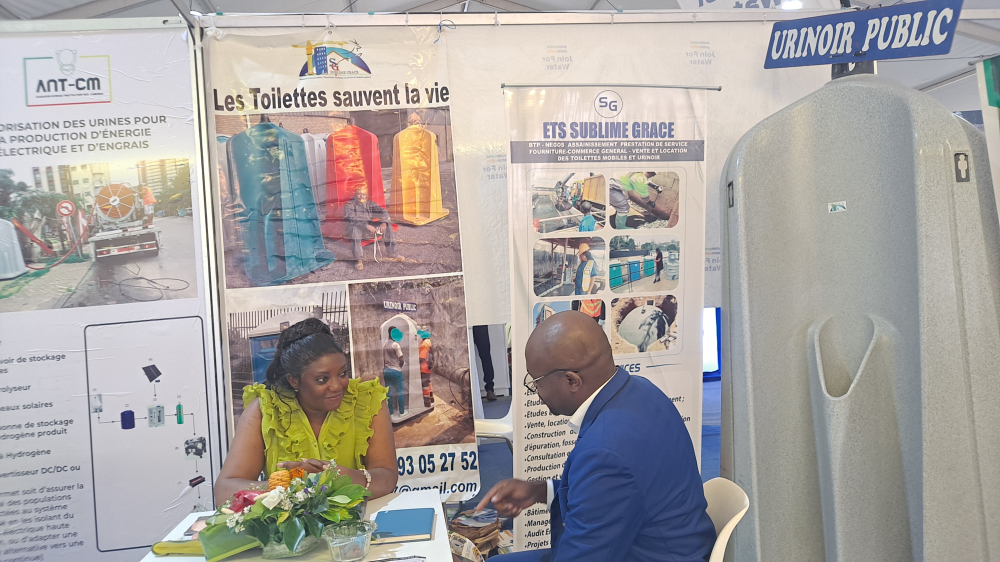
Sublime Grâce company is participating in the 23rd International Congress and Exhibition of the African Water and Sanitation Association, AfWASA in Yaounde from February 9-13, 2026.
The humid, and at the same time wet air of Yaounde buzzes with the energy of 1,500 delegates from 52 nations who have descended upon the Cameroonian capital for the 23rd International Congress and Exhibition of the African Water and Sanitation Association, AfWASA. The date is February 11, 2026, and the atmosphere is charged with urgency. The theme of this year’s gathering, “Water and sanitation for all: Bold actions for Africa,” is not merely a slogan; it is a declaration of intent for a continent striving to meet the basic needs of its booming population.
Quiet Revolution
While the glittering chandeliers of the conference halls shine on discussions about hydrology and water infrastructure, a quiet revolution is being showcased in exhibition Hall 1. It is a revolution that smells less of policy papers and more of pragmatic, on-the-ground engineering. It is here that we meet Djuikouou Ndeffo Christine Flore epouse Talla’a, a woman who wears many hats with grace and authority.
She is the President of the "Toilets for All Cameroon Association," the Chief Executive Officer of Sublime Grâce, a Civil Engineer, a specialist in Strategy and Urban Management, and a dedicated member of the Association of Professional Women of Water and Environment of Cameroon.
Radical, Necessary Vison
In a conversation that cuts through the corporate jargon often found at such summits, Madame Talla’a lays out a vision that is as radical as it is necessary. She is not here to talk about abstract water theories. She is here to talk about waste - specifically, how to manage it, how to monetize it, and how to transform it into electricity and dignity. Her message is clear: Africa cannot solve its water crisis without solving its sanitation crisis, and one cannot exist without the other.
The Orphan Of The Water Sector
For decades, the narrative on water resources in Africa has been dominated by the quest for potable water. Governments and NGOs pour billions into drilling boreholes and laying pipes. Yet, as Madame Talla’a passionately argues, this focus is only half the equation.
"Every time we talk about water, we always put sanitation aside," she says, her voice tinged with frustration. "For us, it has become a stone in the sea to say that sanitation has its place."
The metaphor of a "stone in the sea" - heavy, immovable, and often submerged - paints a vivid picture of the struggle sanitation advocates face. The neglect of sanitation has dire economic and environmental consequences. When human waste is not managed, it contaminates the very water sources governments spend fortunes to treat.
If Only Taken Into Account
"If sanitation is not taken into account, the cost of water treatment will remain enormous," Talla’a warns. "Environmental pollution will no longer be demonstrated. The impact on health, on the environment, will be a real problem."
Her argument is rooted in hard economics. The cost of treating water contaminated by fecal matter is astronomical compared to the cost of preventing the contamination in the first place. Furthermore, the impact on public health creates a cycle of poverty, with waterborne diseases keeping children out of school and adults out of work. But for Talla’a, a Civil Engineer with a strategic mindset, the issue goes beyond economics and epidemiology; it is a matter of human rights.
When Toilets Become “Tools” Of Dignity
"Toilets are dignity," she states simply. In many parts of Yaounde and other African cities, the lack of public toilet facilities forces people to relieve themselves in open spaces, a humiliating and unsafe reality, particularly for women and girls. By providing safe, clean, and accessible sanitation, Talla’a argues that we are not just managing waste; we are restoring humanity to the urban poor.
Black Gold And The Urinal Project
The centerpiece of Sublime Grâce’s exhibition at the AfWASA congress is a deceptively simple structure: an innovative urinal unit for male. It is a product of five years of research and development, a collaboration between Cameroonian ingenuity and French technical expertise. The partners include GAS from Seine-sur-Marne in France, and a team of researchers led by Prof. Pascalin Tiam Kapen, Head of the Renewable Energy Department at the Victor Fotso University Institute of Technology in Bandjoun, Cameroon.
"We have brought a solution to the 'poo-poo' that we find in our cities everywhere," Talla’a explains, using the colloquial term to drive home the visceral reality of urban filth. The design is brilliant in its simplicity and efficiency. The unit measures one meter by ten meters, a compact footprint that allows it to be installed in crowded urban areas where space is at a premium. Despite its small size, it is designed for high capacity, accommodating four people comfortably at a time.
Gender Gap Addressed
Crucially, the project addresses a gender gap often ignored in public sanitation design. While urinals are traditionally associated with men, Sublime Grâce has developed a women’s model that allows women to sit, as they would in a standard toilet, rather than squatting over potentially unsanitary facilities. This design choice is critical for hygiene and safety.
"It prevents users from taking microbes back home," Talla’a notes. This focus on the female user experience is a testament to her leadership in the Association of Professional Women of Water and Environment, AFPEEC, ensuring that women's specific sanitation needs are not an afterthought.
Turning Waste Into Power
Perhaps the most groundbreaking aspect of Talla’a’s project is not the structure of the toilets, but what happens to the waste once it leaves them. In a true display of the "circular economy," Sublime Grâce is not merely disposing of waste; they are transforming it into valuable commodities.
The "black urinals" are not connected to the often-overloaded municipal sewage grids. Instead, they feature an interior reservoir that collects the waste. This is where science takes over. Through a collaboration with Prof. Tiam and his team, the company has developed a system to convert urine and fecal matter into organic fertilizer and, remarkably, electricity.
"We have produced electricity," Talla’a announces with pride. "It is a project of electricity production based on urinals."
Boundless Applications
The science involves processing the collected biological waste to generate biogas, which can then be used for electricity generation. The potential applications for this technology in Africa are boundless. With energy deficits plaguing many African nations, decentralized power generation from waste could be a game-changer.
"It requires a valuation," she says of the waste. "It is not a rare product, it is an available product." By valorizing this abundant resource, the project aims to help solve the electricity problems faced by cities and institutions. Talla’a envisions a future where institutions like hospitals, schools, and prisons become autonomous in their energy needs, using their own waste to power their facilities.
The Logistics Of Dignity: A Full-Service Approach
One of the biggest failures of public sanitation projects in Africa is maintenance. It is a common sight: a brand-new public toilet block built and commissioned with great fanfare, only to fall into disrepair and filth within months due to misuse and lack of cleaning. The "stone in the shoe" for local authorities is the dirty reality of maintaining these facilities.
Talla’a is acutely aware of this pitfall. "Every time we install a new toilet... a few days after, you can no longer recognize it because people have misused it," she admits.
To solve this, Sublime Grâce has decoupled the construction of the toilets from their management. They do not sell the units and walk away. Instead, they offer a comprehensive service package. "We decided at the level of the company to take care of the maintenance ourselves."
Rigorous Logistics
The logistics operation is rigorous. The company operates a specialized truck equipped with a reservoir to syphon the waste from the urinals daily. The company comes every evening to syphon, clean and put it back in service.
This waste is then transported to a storage facility in Douala, where it is treated and processed into fertilizer and electricity. The centralized logistics hub in Douala handles about three deliveries a week, reflecting the high demand in the economic capital. For clients in Yaounde, such as during the AfWASA congress, the company mobilizes the necessary logistics to ensure daily service, ensuring the toilets remain pristine.
The Economics Of Sanitation
Innovation must be financially sustainable to be scalable. Talla’a is transparent about the costs, offering two models for clients: an outright purchase or a rental agreement.
For clients in Cameroon, the sale price of a unit is set at 3 million CFA Francs. This price includes the physical infrastructure. For those who prefer not to make a large capital investment, or who need the units for a specific event or short-term period, the company offers a rental service. "The allocation is between 50,000 and 60,000 per day," Talla’a explains. The final price can vary depending on the city and the logistics involved in delivery and maintenance.
The Maintenance Question
However, Talla’a is quick to clarify that the daily maintenance cost - the syphoning and cleaning - is bundled into the package. "It is already part of the package. In the package, all products and services are negotiated." This all-inclusive pricing model eliminates the risk of the toilets falling into disrepair because the local operator couldn't afford the cleaning fees. It shifts the burden of maintenance from the user to the provider, ensuring quality control.
The demand, she notes, is highest in Douala, Cameroon's bustling commercial hub. "The demand there is much greater." The challenge, however, lies in convincing the gatekeepers of urban development - the mayors and urban community leaders - to prioritize these investments.
The Struggle For Political Will
Despite the clear benefits of the technology, Talla’a faces a familiar hurdle: bureaucratic inertia. When her team approaches local authorities to propose the installation of these urinals, they are often met with hesitation.
"They are not always interested," she says of the local officials. "But we think that innovation is the future."
The reluctance often stems from budgetary constraints and a historical lack of focus on sanitation. Sanitation is the "poor parent" of the water family, often the first item to be cut from municipal budgets. However, Talla’a senses a shift. The realities of field conditions - flooding caused by blocked drains, cholera outbreaks, and unsightly urban squalor - are forcing a reckoning.
Things Might Change - A Bit
"I believe that this year, according to the rumors, some little money has been included in city council budgets for sanitation," she says optimistically. "So we hope that we will be able to have partners there in a clear way for the use of this product."
Her appeal is not just for money, but for a change in mindset. She calls for better training for entrepreneurs in the sanitation sector, arguing that many failures stem from a lack of technical know-how among small operators. By professionalizing the sector and introducing standardized, high-tech solutions, she hopes to attract serious investment from the state and international organizations.
Sublime Grâce: A Holistic Vision
The urinal project is just one facet of Sublime Grâce’s operations. Founded as a public works and construction company, it has evolved into a comprehensive sanitation powerhouse.
Since 2015, the company has been providing septic tank cleaning and pit toilet drainage services, a vital but often overlooked service for households and businesses. “We also handle everything related to degradation, disinfection," ensuring that hazardous waste is treated safely.
Furthermore, the company conducts feasibility studies and rehabilitates ageing sanitation infrastructure. Their portfolio of innovative products extends beyond the "black urinals" to include immorphic toilets (invariant toilets designed for durability), biophilic toilets (incorporating natural elements), and biogas toilets.
Other Products, Services
"We also do the construction of several innovative products," Talla’a lists. "These are also the products that we make in the company."
As a public works company, Sublime Grâce also engages in general construction projects, giving them the engineering capacity to handle large-scale infrastructure challenges. This versatility allows them to approach the sanitation problem from multiple angles - building the physical infrastructure, managing the waste flow, and generating value from the byproducts.
A Call To Action For Africa
As the AfWASA congress draws to a close, the atmosphere in Yaounde is one of cautious optimism. The challenges facing Africa's water and sanitation sector are immense, requiring billions of dollars in investment and decades of sustained effort. Yet, the solutions are being forged right here on the continent.
Madame Talla’a’s journey - from a Civil Engineer to the CEO of a pioneering sanitation company - exemplifies the "Bold Actions" called for by the congress theme. She represents a new generation of African entrepreneurs who are not waiting for aid, but are engineering their own solutions to local problems.
Beautiful Days Ahead
"It is a real pleasure for us to participate in this conference," she concludes. Her belief in the future is unshakable. "Cameroon is already on the right path in terms of sanitation management. We believe that sanitation will have beautiful days in Cameroon, have beautiful days in Africa."
Her final message is a rallying cry for stakeholders across the board. She calls upon communities, local governments, the Cameroonian State, and international organizations to support homegrown initiatives like hers.
"To really support the initiatives that we put in place so that together we can work for a better sanitation for children, women and for the preservation of water quality and even water resources in Cameroon and elsewhere."
In the heart of Central Africa, a quiet revolution is taking ...
Cet article complet est réservé aux abonnés
Déjà abonné ? Identifiez-vous >
Accédez en illimité à Cameroon Tribune Digital à partir de 26250 FCFA
Je M'abonne1 minute suffit pour vous abonner à Cameroon Tribune Digital !
- Votre numéro spécial cameroon-tribune en version numérique
- Des encarts
- Des appels d'offres exclusives
- D'avant-première (accès 24h avant la publication)
- Des éditions consultables sur tous supports (smartphone, tablettes, PC)


Reactions
De la meme catégorie

Affaire Martinez Zogo: Le 36e témoin entre en scène
- 27 Oct 2026 10:04
- 0 likes
Cameroon Medical Council: Newly Elected Pledges to Restore Dignity
- 27 Oct 2026 10:03
- 0 likes



Commentaires