

Beyond The Iron: Training, Not Just Equipment, Is the Future Of Sanitation
- Par Kimeng Hilton
- 11 Feb 2026 23:37
- 0 Likes
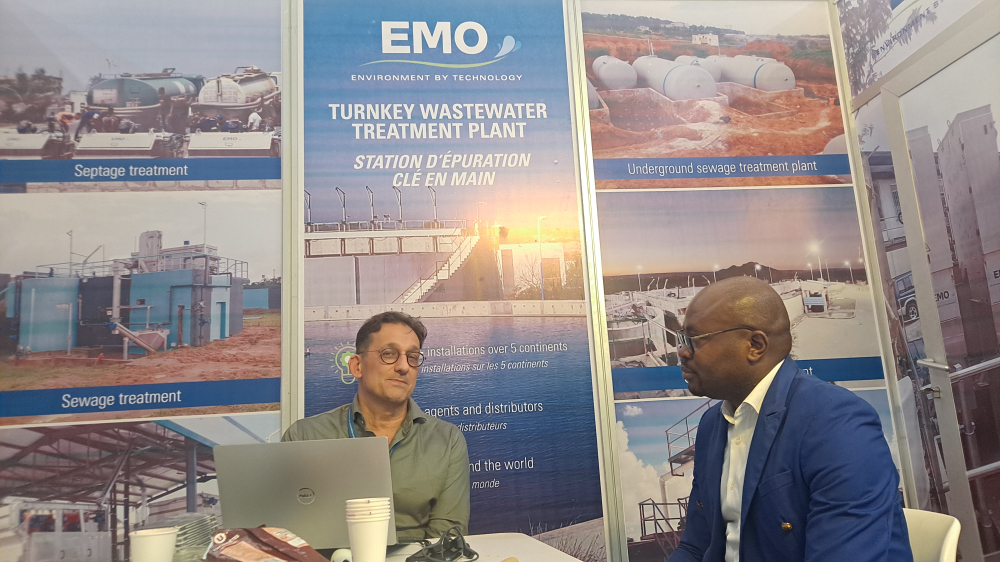
EMO is present at the 23rd International Congress and Exhibition of the African Water and Sanitation Association, AfWASA in Yaounde.
The air inside the convention centre (the Yaounde Congress Hall) giant tent is thick with the hum of negotiations and the quiet, urgent exchange of business cards. It is February 11, 2026, and the city is playing host to the 23rd International Congress and Exhibition of the African Water and Sanitation Association, AfWASA, running from February 9-13, 2026. The theme of this year’s gathering is ambitious, bordering on the desperate: “Water and sanitation for all: Bold actions for Africa.”
Booming Population, Dry Taps
For five days, the Palais des Congrès serves as the beating heart of the continent’s water sector. Over 1,500 participants from 52 countries have converged here – cabinet ministers in flowing robes, technical directors in hard hats, heads of Pan-African institutions… They are here to solve a problem that defines the modern African experience: the gap between the infrastructure needed to support a booming population and the reality of the taps that run dry.
Amidst the sprawling exhibition halls, lined with photographs and videos of massive pumps, pipelines, water reservoirs and industrial machinery, one booth stands out - not for its size, but for the philosophy it represents. EMO, a French company based in the rugged region of Brittany, is here to sell more than just metal. They are here to sell a partnership.
Veteran Of Trade Halls
Olivier Chagot, the Export Manager for EMO, stands at the forefront of their display. He is a veteran of these trade halls, having navigated the expos of the world for over 15 years. As he watches the traffic flow by, he is acutely aware of the stakes. In a continent where nearly 400 million people lack access to basic drinking water, "Bold actions" are not just a slogan; they are a survival strategy.
A Heritage Of Mud And Metal
To understand EMO’s approach to the African market, one must first understand the company’s DNA. EMO is not a startup chasing a trend; it is a battle-tested component of the CEMOSIA group, a consortium of seven environmentally focused companies.
“We started about 40 years ago,” Chagot explains, his voice carrying the lilt of a man who has spent a lifetime discussing heavy industry. “At the beginning, EMO started with the treatment of mud - sludge from cleaning stations, especially urban and industrial.”
It is an unglamorous origin story. In the world of water utilities, sludge is the messy byproduct that everyone wants to forget. But EMO embraced it. They treated the mud. They mastered the chemistry of waste. Over the decades, this expertise acted as a springboard. They expanded from merely treating the byproduct to manufacturing the entire electromechanical ecosystem of a wastewater treatment plant.
Multi-purpose Solutions
“Today, we can offer all the electromechanical equipment, waste water treatment stations, and in particular, drainage wells,” Chagot says. “We can also make key solutions by hand. We offer the customer the whole solution, not just the equipment supplier.”
This evolution - from a niche sludge handler to a full-service provider - is central to their strategy. In an industry often fragmented between manufacturers, civil engineers, and chemical suppliers, EMO positions itself as a one-stop shop. They design the process, analyze the water chemistry in their own laboratories, fabricate the metal structures in their workshops, and finally, install the machinery.
It is a comprehensive capability that belies their size. “It's a small group of SMEs,” Chagot admits, referring to the Small and Medium-size Enterprises that make up the CEMOSIA group, “but very dynamic in export.”
That dynamism has taken them far. Today, EMO equipment operate in 121 countries. From the frozen pipelines of Northern Europe to the humid tropics of West Africa, their machinery is turning wastewater into resources.
The African Puzzle
Chagot’s relationship with Africa is deeply personal. For 15 years, he has crisscrossed the continent, building a network of relationships that spans 20 countries and over 200 project references. He understands that doing business in Africa requires a different playbook than doing business in Paris or London.
“I think we really had an export mentality,” Chagot reflects. “That is, everywhere we go, we adapt to the local cultures and traditions.”
This adaptability is crucial. Africa is not a monolith; it is a mosaic of regulatory environments, climatic challenges, and logistical constraints. A solution that works in the highlands of Ethiopia may fail in the coastal humidity of Cameroon. EMO’s strategy involves integrating engineering upstream - analyzing the specific chemical and physical requirements of a site before a single piece of metal is cut.
Edge Over Competitors
“We integrated a whole part of analysis, engineering, we have a laboratory with chemists,” Chagot notes. “These are essentially manufacturing workshops, metalwork, metal construction. We integrated the engineering part, process, upstream. And so we do analysis, and then we decide on the products and on the solutions that we will propose.”
It is a rigorous process, but Chagot believes it gives them an edge over competitors who simply sell catalog items off the shelf. However, one significant piece of the African puzzle remains missing for EMO: Cameroon.
The Cameroon Opportunity
Standing in the heart of Yaounde, Chagot is acutely aware of the irony. He has sold equipment in Ghana and Ivory Coast. He has done major work further east in Ethiopia. Yet, in the very country hosting the continent’s premier water congress, EMO has yet to install a single piece of equipment.
“In Cameroon, we have made several visits,” Chagot says. “We have contacts, of course, with Camwater, with other companies. But for now, we haven't had the chance to put equipment in Cameroon yet. We hope it will come soon.”
Looking For Foothold
Camwater, the Cameroon Water Utilities Corporation, is the dominant player in the country’s water sector. For a company like EMO, breaking into the Cameroonian market is not just about selling a pump; it is about establishing a foothold in a strategic Central African hub.
Chagot’s mission at this congress is clear: he is looking for partners. He isn’t necessarily looking to sell a single unit to a homeowner. He is hunting for symbiotic relationships with two distinct groups: local distributors who can handle the logistics of moving heavy machinery, and civil engineering groups building treatment plants, but need specialized equipment and engineering support.
Distributors Required
“We are obviously looking for partners who could help in the distribution of products in Cameroon, and then also partners, civil engineering groups who would like to construct treatment stations,” he explains. “We could help them in the engineering part and the equipment supply part, as we did in other neighboring countries in Africa.”
It is a pitch built on mutual benefit. EMO brings the high-tech French engineering and the manufacturing muscle; the local partners bring the ground knowledge, the civil construction capability, and the relationships.
The Efficiency Of The Congress
Chagot’s commitment to AfWASA is unwavering. He has been a faithful attendee of the "Salon" for over 15 years, rarely missing an edition. In an era of digital communication and Zoom meetings, his devotion to the physical trade show might seem old-fashioned, but he insists it is the most efficient tool in his arsenal.
“Imagine if we wanted to see these people [by going] to all the countries, it would take more than a year,” Chagot argues, gesturing to the bustling hall. “Here we see a lot of people on a short stay, so it's really very effective.”
Force Multiplier
For an export manager, the congress is a force multiplier. It compresses the timeline of business development. In a single week, he can meet with cabinet ministers from West Africa, technical directors from East Africa, and potential partners from Central Africa. It is a microcosm of the entire continent’s water sector, contained within a few convention halls.
But the work isn't just about shaking hands. It is about communicating value. With hundreds of companies vying for attention, Chagot must articulate what makes EMO different.
The "White Elephant" Problem
The most compelling part of Chagot’s pitch isn’t about the specifications of their steel or the power of their pumps. It is about a phenomenon he calls the “mistakes of the past.”
Across the developing world, and particularly in Africa, graveyards of infrastructure exist. Water treatment plants that were built at great expense, inaugurated with ribbon-cutting ceremonies, and then left to rust within a few years. These are "white elephants" - monumental failures that occur not because the machinery was bad, but because the human infrastructure was missing.
“Unfortunately, there are many cases of stations that are stopped as soon as the manufacturer left the station,” Chagot says with a note of frustration in his voice. “There are not enough trained operators to maintain the installations, so it's really a major concern.”
Of Follow-up, Maintenance
This is the critical bottleneck in African water development. Money is raised. Concrete is poured. Machinery is installed. And then, the first time a complex filter clogs or a sensor fails, the entire plant shuts down because no one on-site knows how to fix it.
Chagot and EMO have decided that they will not be complicit in this cycle anymore. Their strategy has shifted from a "sell and leave" model to a "build and sustain" model.
“We hope to be able to change that with assemblies, partnerships, maintenance contracts, things like that,” Chagot says. “That's what's important, I think, especially for the African continent.” This commitment to sustainability manifests in a robust focus on training. EMO doesn't just deliver a manual; they deliver knowledge. Chagot recounts a recent success story in Ghana to illustrate the depth of this commitment.
Examples From Africa
“We built a big station in Ghana on the edge of the village, and we received, for about 10 days, operators from the station in Ghana who came to train in France,” he recalls. “They also trained in a water treatment school in France. They really acquired the technology, the knowledge, to operate the station.” For Chagot, the distinction is vital. “Bui...
Cet article complet est réservé aux abonnés
Déjà abonné ? Identifiez-vous >
Accédez en illimité à Cameroon Tribune Digital à partir de 26250 FCFA
Je M'abonne1 minute suffit pour vous abonner à Cameroon Tribune Digital !
- Votre numéro spécial cameroon-tribune en version numérique
- Des encarts
- Des appels d'offres exclusives
- D'avant-première (accès 24h avant la publication)
- Des éditions consultables sur tous supports (smartphone, tablettes, PC)


Reactions
De la meme catégorie

Affaire Martinez Zogo: Le 36e témoin entre en scène
- 27 Oct 2026 10:04
- 0 likes
Cameroon Medical Council: Newly Elected Pledges to Restore Dignity
- 27 Oct 2026 10:03
- 0 likes



Commentaires