

Preserving The Ancient, Embracing The Inevitable
- Par Kimeng Hilton
- 22 Jan 2026 18:50
- 0 Likes
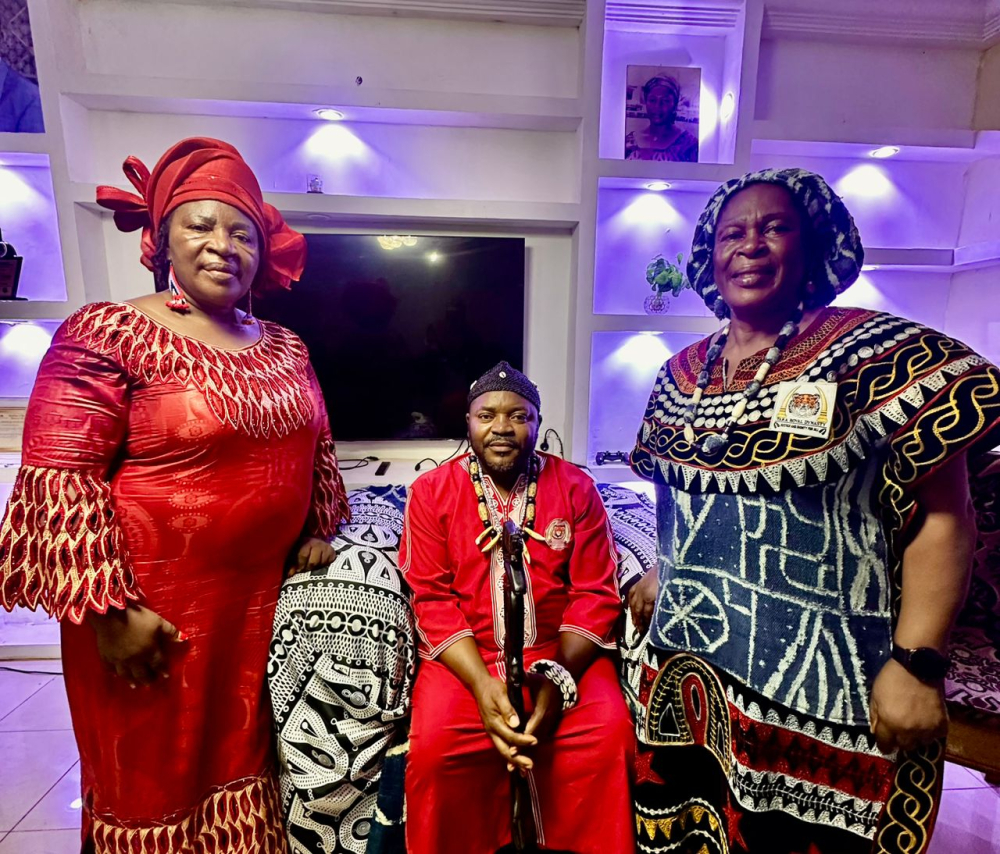
Fo’o Muluh Taka IV, the Fon of Muwah in Pinyin Clan in Mezam Division of the North West Region has elevated Mrs. Mary Taka Tanni and Mrs. Justine Taka Tamumgang to very senior royal roles.
The air in the Damase neighbourhood of Yaounde in the evening of January 20, 2026, was thick. With the kind of electric anticipation that precedes a shift in history. The humidity of the dry season clung to the walls of the modest, yet Stately home of Mrs. Mary Taka Tanni.
But inside the compound, the atmosphere was cooled by the weight of tradition and the gravitational pull of royalty. It was not the usual clamor of a political rally or the chaotic energy of a city celebration. It was the deep, resonant silence of respect, punctuated by the rhythmic affirmation of a people witnessing their culture being re-written.
A Visit To Transform
His Royal Highness, Fo’o Muluh Taka IV, the Fon of Muwah in Pinyin Clan in Mezam Division of the North West Region, had not come to Yaounde merely to visit. He had come to transform. Under the canopy of the evening sky, far from the traditional seat of his forefathers in the North West Region, a decree was spoken that would ripple through the annals of the Muwah Kingdom. It was a royal decree that shattered centuries of patriarchal precedence, elevating women not just as participants in the palace, but as its very pillars and its conscience.
Two Women On Pedestal
In a dual ceremony that blended the ancient with the modern, the Fon bestowed upon two distinguished daughters of the soil - retired Senior Journalist Mary Taka Tanni and retired Director of Community Development Justine Taka Tamumgang - titles of such weight and sanctity that they altered the very structural DNA of the Muwah Royal Palace. This is the story of that night, the story of the women who stood tall, and the story of a King who dared to look into the eyes of tradition and tell it that the future is female.
Silence Before The Crown
To understand the magnitude of what transpired on that Tuesday evening, one must first understand the rigid architecture of tradition from which it emerged. In the vast, vibrant tapestry of Cameroonian chieftaincy, particularly within the Grassfields of the North West Region, the throne has historically been a masculine mountain. It is a structure built on the foundation of Fons, Fais, and Chiefs, with women often serving as the supporting soil - essential, yes, but rarely permitted to scale the peak.
For Generations…
For generations, the narrative was unyielding. Women were the heart of the home and the bearers of lineage, but the public face of authority, the voice of the decree, and the hand of the scepter were almost exclusively male. Even the most industrious woman, the wisest matriarch, or the fiercest protector of her clan often found her influence ceilinged by the invisible glass walls of custom.
Yet, history is not a stagnant river; it is a torrent that carves new paths when the rains are heavy enough. On this night, the rain came in the form of HRH Fo’o Muluh Taka IV. A monarch who has spent his reign observing the quiet, often overlooked labour of his female subjects, he arrived in Damase with a purpose that went far beyond a mere social call. He arrived to validate the women who had spent decades holding up the sky while men stood on the ground.
Befitting Setting
The setting was intimate. The home of Mary Taka Tanni, a woman who had spent a lifetime speaking truth to the nation through the airwaves of Cameroon Radio Television (CRTV), now became the ad-hoc throne room. It was a fitting metaphor for the evening’s theme. The domestic sphere, traditionally the domain of the woman, was being elevated to the status of a royal court.
Channeling The Spirits Of Ancestors
As the Fon took his seat, surrounded by elders, family members, and dignitaries, there was a palpable sense that the ancestors were present. In African cosmology, time is not a straight line but a circle; the past lives in the present. By invoking the "sacred authority of the ancestors of Muwah," the Fon was not just acting as a modern leader; he was channeling the spirits of those who came before, seeking a new kind of mandate for a new era.
Mary Taka Tanni - The Keeper Of The Dignity
The first honour of the evening was reserved for the hostess, Mrs. Mary Taka Tanni. The announcement fell like a gentle, but firm hammer striking an anvil. "In recognition of her unwavering service, proven wisdom, cultural stewardship, and the deep respect she commands within the Muwah Royal Palace and beyond," the citation began and echoed through the compound.
The title bestowed upon her was Ma’ah Nyingfor wa Muwah. To the uninitiated, the words sound like poetry, a melodious string of vowels and consonants. But to the Muwah people, the title is a theological and sociological masterpiece. It translates to "Mother of Honor, Guardian of Royal Dignity."
Due Traditional Acknowledgement
To be called Ma’ah is to be recognized as a mother in the truest, most expansive sense of the word. It is motherhood beyond blood. It is the matriarch who nurtures the clan not just with food, but with wisdom, protection, and moral fortitude. But it is the second half of the title – Nyingfor - that carries the profound weight of the evening’s philosophy. Nyingfor means “Honor.” It means “Dignity.” It means “Truth.”
In the citation read by Gideon Taka Junior, Mary was described as a woman whose influence "preserves harmony, upholds truth, and strengthens the dignity of the throne." This was not merely a ceremonial accolade; it was a job description. She was being appointed as the moral compass of the palace.
Expectedly Glad
When the microphone was handed to her, the usually articulate veteran journalist found herself in a rare moment of speechlessness. "I was really elated," she confessed, her voice trembling with the gravity of the moment. "I must say I was humbled because it is something I was not expecting, honestly. It came as a pleasant surprise."
Mary’s reaction revealed the authenticity of the moment. Here was a woman who had interrogated Presidents and analyzed national crises, now undone by the recognition of her own father, the King. "The Fon has recognised some of us, all women," she noted, highlighting the seismic shift. "Before now, a woman had no place in society, even in royalty. But the Fon thought it necessary to change the narrative by recognizing the efforts of some Muwah women."
True To Character
Her acceptance speech was a testament to her character. She did not promise grandiose wealth or military might; she promised truth. "I stand for truth and for upholding the Muwah Royal Palace; I stand for its integrity," she declared.
This is the essence of Ma’ah Nyingfor. In a world where royalty is often associated with opulence and distance, Mary Taka Tanni’s title brings royalty back to its roots: integrity. She is the Guardian of Dignity, the one who watches the throne not to see how high it sits, but to see how straight it stands. "The Fon of Muwah, my father, has broken a record," she said, her voice gaining strength. "And I think posterity will emulate him."
Living Conscience Of Kingdom
Indeed, breaking records is often painful. It requires shattering old molds. But Mary Taka Tanni, with her background in journalism - profession dedicated to transparency and accountability - is uniquely qualified to mould the pieces of that shattered tradition into something more inclusive.
"I will continue to defend the Palace, to defend my family to any extent," she vowed. It was the declaration of a lioness in sheep’s clothing, a gentle hand that would turn to iron if the honour of her people was threatened. As Ma’ah Nyingfor, she becomes the living conscience of the Kingdom, the voice that whispers in the King’s ear when he strays, and the shield that protects the reputation of the throne from slander and decay.
Justine Taka Tamumgang - The Pillar Of Strength
If the first title was about the soul of the palace, the second title was about its spine. The Fon turned his gaze to Mrs. Justine Taka Tamumgang, a retired Director of Community and Local Development in the Ministry of Agriculture and Rural Development. Her career had been defined by action, by the gritty work of development, by bringing resources to the rural areas and building infrastructure where none existed.
Now, she was being called to build something far more permanent than roads and bridges. She was being asked to build the stability of the throne. The proclamation was resounding: "By the sacred authority of the ancestors of Muwah, she is hereby proclaimed and designated as Ma’a Pifor wa Muwah."
Backbone Of Traditional Authority
Ma’a Pifor. Mother of Strength. Pillar of Royal Authority. The linguistic power here is undeniable. Pifor is not just physical strength; it is the backbone. It is the structural integrity that holds a house together when the storms of history batter against it. In a society that often views strength as a masculine trait, the Fon was canonizing the feminine form of resilience.
The citation was explicit: "A woman whose firmness preserves discipline, whose wisdom upholds justice, and whose presence reinforces the dignity and stability of the throne." Justine Taka Tamumgang is not a stranger to heavy lifting. In the Ministry of Agriculture, she navigated the complex bureaucracies of rural development. But this new role transcended bureaucracy. It was an ancestral mandate. She was to be the "Pillar" - a term that implies foundational support. Without a pillar, the roof collapses. Without Ma’a Pifor, the kingdom crumbles.
No Boundary
"I feel so happy. I feel so honoured. I feel blessed by my father," Justine said, her face glowing with a mix of shock and pride. "It's a unique occasion. I feel so elated." She recognized the weight of the title, immediately pivoting to the spiritual dimensions of her new task: "It embodies a lot," she acknowledged. "As the Fon rightly said, love, peace and unity have no boundary. I pray God grants me the strength and wisdom required to carry out this mission."
But the Fon did not stop there. In a move that sent shockwaves through the traditional hierarchy, he appended a political and administrative dimension to Mrs. Tamumgang’s spiritual title. He declared her the Official Representative of the Fon of Muwah in Yaounde and the entire Centre Region.
Direct Line Of Royal Authority
This was a masterstroke of governance. By appointing Ma’a Pifor as his representative, the Fon was establishing a direct line of royal authority in Cameroon’s capital, bypassing traditional intermediaries. He was placing a woman at the helm of his Diaspora relations and institutional dealings in Yaounde.
Furthermore, in a gesture of profound symbolism, he decreed that her private residence in Yaounde would henceforth be officially recognized and designated as "The Muwah Palace, Yaounde."
Her living room, once a space for family gatherings, was now a sovereign seat. Her dining table, a council ground. This act democratized and decentralized the concept of royalty. It brought the palace to the people. It stated clearly that the presence of the King is not confined to the grasslands of the North West Region; but resides wherever his Ma’a Pifor stands.
Historical Significance
"His Royal Highness Fo’o Muluh Taka IV is a traditional ruler who has gone beyond the boundary of tradition," Justine noted, articulating the historical significance of the night. "Cameroon’s traditions do not give women such powers. The Fon takes into consideration gender equality. He gives value where it is due."
Her statement captures the essence of the evening: the intersection of tradition and modern values. Gender equality is often seen as a Western import, a concept alien to African custom. Yet, here was the Fon of Muwah, an ultimate traditionalist, arguing that gender equality is not a betrayal of tradition, but a necessary evolution of it.
The Visionary Architect
As the applause died down and the new titleholders sat in their places of honour, the spotlight shifted to the architect of this transformation. HRH Fo’o Muluh Taka IV sat with the calm demeanor of a man who has made peace with his decisions. He is a monarch of the 21st Century, navigating the treacherous waters between preserving the ancient and embracing the inevitable.
When asked why he chose to elevate women to such senior positions - excluding men entirely from this specific round of honors - his answer was as direct as it was revolutionary. "I grew up observing that African tradition, particularly that of the North West Region, women are always left behind," the Fon explained.
His voice carried the weight of observation, not just theory. He had seen the injustice with his own eyes. "No matter how hard they work, even if they work at the same capacity with men, men traditionally have the opportunity to be easily named family successors, notables, kingmakers… It is rare to see a woman in that position."
Addressing Systemic Imbalance
He acknowledged the systemic imbalance. He admitted that the traditional structures were skewed. And then, he did what few leaders dare to do: he announced a transformation. "And therefore we are undertaking transformation," he declared. "We are innovating culture at that level."
The phrase "innovating culture" is a powerful oxymoron. Culture is often viewed as static, something to be preserved in amber. But HRH Fo’o Muluh Taka IV understands that culture, like fire, must consume new fuel to keep burning. If it does not adapt, it dies. "One of my interests is to give women the opportunity to lead, bring women into traditional leadership, and recognise them for the wonderful work they have been doing over the centuries without proper recognition," he stated.
Beyond Tokenism
This is not tokenism; it is restitution. It is a debt being paid to the countless unnamed women who carried the kingdom on their backs while men sat on the thrones. The Fon spoke about the specific qualities of the women he chose. He mentioned that these were women who had "demonstrated significant courage to meet the various objectives."
He called them "key unifiers." He also revealed a strategy, a deliberate pattern to his reign. "I was in Ebolowa in the South Region two days ago (January 18, 2026) where I also gave the title of Ma’ah Nyingfor wa Muwah. These are three women whom I have put in front as key traditional authorities."
The geography of his actions is telling. Ebolowa in the South, Buea in the South West, Yaounde in the Centre. The Fon is scattering these seeds of female leadership across the national soil, creating a network of Ma’ahs who represent the face of Muwah to the entire nation.
"Yes, and I think that it's proper to begin to recognise women where possible," he concluded, his tone leaving no room for argument. It was a statement of finality. The debate was over. The era of exclusion had ended.
Decoding The Lexicon Of Power
To truly appreciate the events of January 20, 2026, one must engage in a linguistic excavation of the titles conferred. These are not just names; they are containers of cultural philosophy.
Ma’ah (Mother): In the Muwah context, this term transcends biology. Biology is a lottery; spiritual motherhood is a choice. A Ma’ah is a nurturer of the social fabric. She is the one who mourns with the bereaved and celebrates with the victorious. By designating these women as Ma’ah, the Fon is acknowledging that the State requires the same care, patience, and nurturing that a mother gives to a child. The "hard power" of the spear is being balanced by the "soft power" of the womb.
The Weight Of Titles
Nyingfor (Honor/Dignity): This is the currency of royalty. Without honour, a king is merely a tyrant. Nyingfor represents truth, integrity, and noble conduct. In a world often plagued by political duplicity, the Ma’ah Nyingfor is the standard-bearer of authenticity. She is the one who ensures that the palace never lies to the people. Mary Taka Tanni’s career in journalism is the perfect crucible for this role. She has spent her life verifying facts; now she is the guardian of the Kingdom’s truth.
Pifor (Strength/Backbone/Authority): If Nyingfor is the soul, Pifor is the skeleton. Pifor implies the structural integrity required to withstand pressure. It is the firmness of a mother disciplining a child, not out of anger, but out of a desperate need to see them grow upright. For Justine Taka Tamumgang, this title recognizes her administrative rigour. It acknowledges that "womanliness" is not synonymous with "weakness." A woman can be a pillar. She can be the rock upon which the community rests.
Not Abstract Honours
Wa Muwah (Of Muwah): The suffix binds them to the land. It is a territorial claim. These titles are not abstract honours; they are rooted in the soil of the kingdom. Whether they are in Yaounde, Ebolowa, or the village itself, they carry the essence of Muwah with them. They are mobile ambassadors of a stationary heritage.
By combining these terms, the Fon has created a new lexicon of power. It is a power that is maternal yet authoritative, dignified yet strong, and traditional yet progressive.
Cet article complet est réservé aux abonnés
Déjà abonné ? Identifiez-vous >
Accédez en illimité à Cameroon Tribune Digital à partir de 26250 FCFA
Je M'abonne1 minute suffit pour vous abonner à Cameroon Tribune Digital !

- Votre numéro spécial cameroon-tribune en version numérique
- Des encarts
- Des appels d'offres exclusives
- D'avant-première (accès 24h avant la publication)
- Des éditions consultables sur tous supports (smartphone, tablettes, PC)


Reactions
De la meme catégorie

Affaire Martinez Zogo: Le 36e témoin entre en scène
- 27 Oct 2026 10:04
- 0 likes
Cameroon Medical Council: Newly Elected Pledges to Restore Dignity
- 27 Oct 2026 10:03
- 0 likes





Commentaires