
Beyond The Finish Line: Cameroon’s Culture Conquers Africa’s Highest Peak
- Par Kimeng Hilton
- 13 Feb 2026 22:43
- 0 Likes
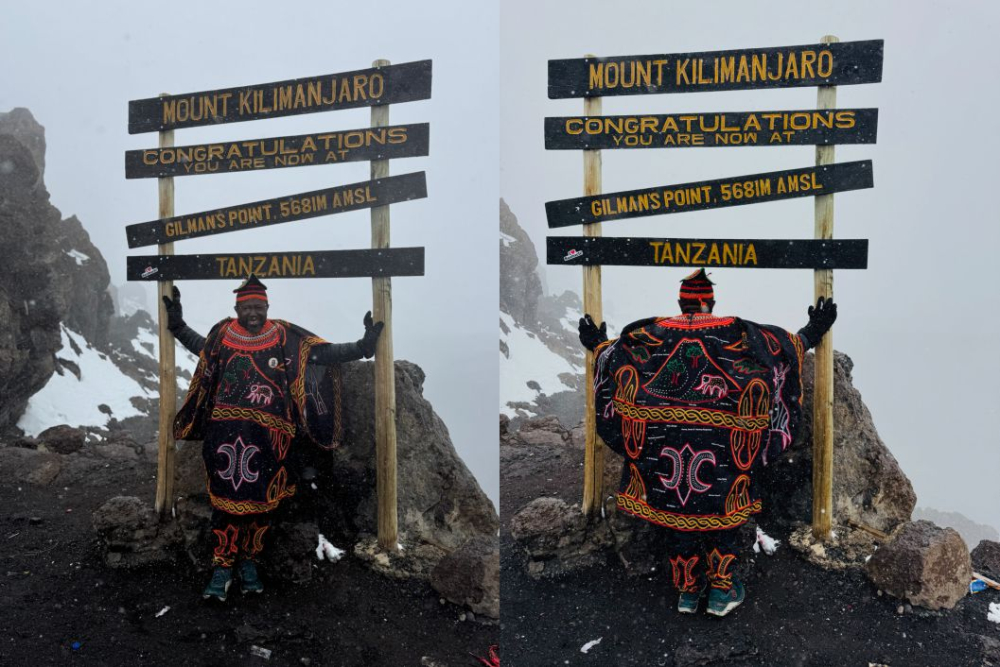
Afowiri Kizito Fondzenyuy, a Cameroonian marathoner for charitable causes, recently completed the “Seven Continents” challenge by climbing up Mount Kilimanjaro in Tanzania.
At 5,895 meters above sea level, the air is thin, a scarce luxury that the lungs must fight to claim. The wind here does not just blow; it cuts, carrying with it the biting chill of a climate that belongs to a different world. This is the "Roof of Africa," the snow-capped summit of Mount Kilimanjaro, a place where the earth touches the sky and where only the most resilient dare to tread.
One Of Few Africans
It was here, amidst the silence of the clouds and the jagged beauty of Tanzania’s volcanic highlands, that Afowiri Kizito Fondzenyuy, a Cameroonian marathoner for charitable causes, etched his name into the annals of history. He did not come with an army or a fleet of ships; he came with the beating heart of a runner and the heavy, vibrant fabric of a nation draped over his shoulders.
By completing the prestigious Mount Kilimanjaro Summit Marathon, Fondzenyuy officially became one of the few Africans to conquer the grueling "Seven Continents" marathon challenge. But this was more than a checkmark on a bucket list. It was a profound statement of identity, a diplomatic triumph, and a beacon of hope for a cause that often goes unheard.
The Descent Into Madness
To understand the magnitude of this achievement, one must first understand the beast that Fondzenyuy tamed. The Mount Kilimanjaro Summit Marathon is not a race for the faint of heart. Unlike the flat, rhythmic cadence of major city marathons like London or Boston, where the roads are smooth and the crowds are deafening, Kilimanjaro offers no such comforts.
This is a race that demands a sacrifice from the body. It unfolds on rugged high-altitude terrain, a punishing landscape of steep trails, loose scree, and treacherous volcanic paths. Here, the weather is a fickle adversary; one moment the sun beats down with an equatorial fury, and the next, mist and freezing fog envelop the runner, disorienting the senses.
The Most Difficult Ever
Fondzenyuy, a seasoned endurance athlete with 20 marathons under his belt, described this race as the most difficult of his career. Consider the weight of that statement. This is a man who has run in the bone-chilling freeze of Antarctica, where the cold is so intense it freezes the moisture in your nose.
Yet, it was the slopes of Kilimanjaro that tested him the most. The altitude turns simple movement into a laborious task. Every step is a negotiation with gravity, every breath a plea for oxygen. To complete 42 kilometers in such an environment is to push the human body to the very brink of its capabilities.
But as he navigated the treacherous descents and lung-burning ascents, Fondzenyuy was fueled by something more substantial than glucose or electrolytes. He was propelled by the weight of a dream that had taken him across the globe.
A Tapestry of 20
The Kilimanjaro race was the final jewel in a crown that took a decade to forge. With this summit, Fondzenyuy has now completed exactly 20 marathons worldwide. His is a resume of true global citizenship: the frozen silence of Antarctica; the bustling, neon-lit streets of Asia; the historic avenues of Europe; the vast stretches of North America; the passionate rhythms of South America; the unique, sun-baked terrains of Australia; and finally, the towering majesty of Africa.
This is the "Seven Continents" milestone, an exclusive club that fewer people than have been to space have joined. To do it as an African is a rarity; to do it as a Cameroonian is a pioneering feat.
Museum Of Cameroonian Culture
Each of these 20 races was a chapter in a larger story. They were a testament to the "Toghu Marathoner’s" unyielding spirit. Six of these continents were conquered while wearing full traditional Cameroonian Toghu attire. Imagine, for a moment, the contrast: in Antarctica, surrounded by white scientists and explorers in high-tech Gore-Tex, there stood Fondzenyuy, wrapped in the thick, embroidered velvet of his homeland. In the sleek, modern cities of the Western world, amidst runners branded with corporate logos, he ran as a walking, breathing museum of Cameroonian culture.
He carried the colors, the patterns, and the prestige of the Grassfields regions to the ends of the earth. With every stride, he projected Cameroon’s cultural identity onto the global stage, refusing to let his heritage be diluted by the homogenizing culture of international sports. He showed the world that a Cameroonian can compete anywhere, at any level, without compromising who they are.
The Symbolism Of The Summit
If the previous six continents were about projection - taking Cameroon to the world - the seventh continent was about reflection and reclamation. Returning to Africa to finish the journey held a deep spiritual significance.
Because of the extreme difficulty of the Kilimanjaro terrain, running the full race in the heavy, royal Toghu would have been physically dangerous. The heat generated by such heavy attire at high altitude could have led to exhaustion. But the Toghu had to be there. In a masterful stroke of symbolic genius, Fondzenyuy carried the Toghu to the summit.
Celebrating Culture On Highest Peak
Standing on Uhuru Peak, the highest point in Africa, he held the traditional attire aloft. It was a powerful visual metaphor: the culture of Cameroon, standing atop the continent, looking down at the world. It was a declaration that no matter how high one climbs, one’s roots remain the foundation of their strength.
"As I stand here, your son and brother, we have completed a marathon on every continent," he said, his words likely carried away by the wind but resonating in the hearts of those watching from afar. "The seventh continent was a moment to celebrate our culture at Africa’s highest point."
This phrase, "your son and brother," is the key to understanding the man. In a world of sports dominated by individual ego and brand endorsements, Fondzenyuy positions himself as a servant of his people. He did not climb for himself; he climbed for the collective. He ran so that Cameroon could stand a little taller.
A Race With A Heart: The Amom Foundation
However, the glory of the summit was not the only objective. Fondzenyuy’s endurance has always been matched by his empathy. Beyond the spectacle of sport, the Kilimanjaro summit run carried a clear, urgent social purpose. It was dedicated to autism awareness and neurodiversity advocacy through the Amom Foundation.
In many parts of the world, autism awareness is gaining ground, but in many African communities, it remains a topic shrouded in stigma, silence, and misunderstanding. Children on the autism spectrum are often marginalized, misunderstood, or hidden away by families who lack the resources to support them. The struggle of a parent trying to navigate a world that does not understand their child is a marathon of its own—a grueling, endless endurance test with no finish line in sight.
Fundraiser For Social Causes
Fondzenyuy decided to link his physical marathon to this social one. He used the platform of the Kilimanjaro challenge to fundraise for the Amom Foundation, aiming to turn the sweat of his brow into support for the neurodiverse community.
The response was electric. Fundraising efforts linked to the race reached their target within weeks. This speed was a testament to the power of the narrative. It showed that Cameroonians, both at home and in the vast diaspora, were ready to rally behind a cause that was presented to them with courage and clarity. They donated not just to a charity, but to a vision of a more inclusive society.
Of Autism And Awareness
The impact of this victory is already being felt on the ground. Autism awareness activities have commenced in Bamenda through the Amom Foundation. This is not merely theoretical advocacy; it is a boots-on-the-ground operation. Teacher training sessions are underway, equipping educators with the skills to identify and support neurodiverse students. Parent education programs are launching, giving families the tools they need to advocate for their children.
The organizers have indicated that this is just the beginning.
Expansion to other regions of Cameroon is planned, creating a ripple effect that started on the summit of a mountain and will flow into classrooms and living rooms across the nation. By running for autism, Fondzenyuy has given a voice to the voiceless, proving that the most enduring legacy of an athlete is not the medal around the neck, but the lives changed along the way.
Sports Diplomacy: The Soft Power Of The Toghu
In the corridors of power, diplomats wield treaties and trade agreements. But on the world s...
Cet article complet est réservé aux abonnés
Déjà abonné ? Identifiez-vous >
Accédez en illimité à Cameroon Tribune Digital à partir de 26250 FCFA
Je M'abonne1 minute suffit pour vous abonner à Cameroon Tribune Digital !

- Votre numéro spécial cameroon-tribune en version numérique
- Des encarts
- Des appels d'offres exclusives
- D'avant-première (accès 24h avant la publication)
- Des éditions consultables sur tous supports (smartphone, tablettes, PC)


Reactions
De la meme catégorie

Affaire Martinez Zogo: Le 36e témoin entre en scène
- 27 Oct 2026 10:04
- 0 likes
Cameroon Medical Council: Newly Elected Pledges to Restore Dignity
- 27 Oct 2026 10:03
- 0 likes




Commentaires