

Smoke-Free, Heart-Free: Bold Stride Toward Inclusive, Healthy Environments
- Par Kimeng Hilton
- 26 Feb 2026 15:50
- 0 Likes
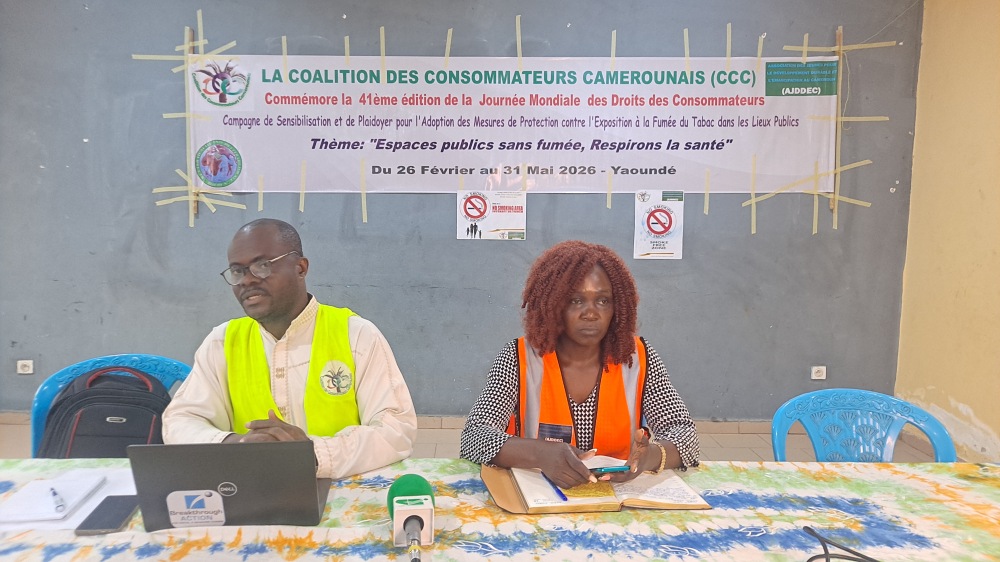
The Cameroonian Consumer Coalition, CCC and the Association of Youth for Sustainable Development and Emancipation in Cameroon, AJDDEC, held a press conference in Yaounde on February 26, 2026. To raise awareness on the risks of smoking to bystanders.
The air in the press conference room in the Yaounde neighbourhood of Ekie was still, but the atmosphere was charged with a sense of urgent determination. Outside the windows of the venue, the bustling life of the Cameroonian capital continued - a city vibrant with commerce, transport, and social interaction. Yet, invisible to the naked eye, a toxic cloud hangs over much of this daily life, a pall that claims health and vitality with every passive inhalation.
Steadfast Partnership
It was against this backdrop that the Cameroonian Consumer Coalition, CCC, in steadfast partnership with the Association of Youth for Sustainable Development and Emancipation in Cameroon, AJDDEC, convened a press conference that would mark a pivotal moment in the nation’s public health narrative. The date, February 26, 2026, was not chosen at random; it serves as the launching pad for a series of activities culminating in the 41st World Consumer Rights Day on March 15, 2026.
Plea And Promise
The theme of CCC’s campaign is both a plea and a promise: "Smoke-free public spaces, let's breathe health." It is a clarion call to action directed at policymakers, economic operators, and ordinary citizens alike. At its heart, this campaign is about more than just tobacco. It is about the fundamental human right to inhale air that does not carry the specter of disease.
Nation Of Involuntary Smokers
To understand the gravity of the situation, one must look beyond the visible smoker to the invisible victims. Prince Mpondo, the President of the Cameroonian Consumer Coalition, opened the press conference with a startling juxtaposition of numbers that lays bare the sheer scale of the crisis.
Citing data from the Global Adult Tobacco Survey, GATS, conducted by the Cameroon Ministry of Public Health in 2013, Mpondo highlighted a distressing statistic: Cameroon is home to approximately 1.1 million active tobacco smokers. While this figure is significant in its own right, it pales in comparison to the number of innocent bystanders affected by the habit.
7 Million Exposed To Tobacco Smoke
"Nearly 7 million Cameroonians are involuntarily exposed to tobacco smoke in public places," Mpondo stated, his voice heavy with concern. "We clearly see that 1.1 million smokers expose nearly 7 million non-smokers who will unfortunately suffer the same health consequences as active smokers."
This is the crux of the issue. The math is terrifyingly simple: a minority is imposing a lethal health risk on the majority. In restaurants, bars, public transport vehicles, and even administrative offices, the air is often thick with the haze of burning tobacco. For the 7 million - men, women, and children - choice has been removed from the equation. They are breathing not air, but a cocktail of thousands of chemical substances, many of them being recognized carcinogens.
Vector For Several Health Challenges
Tobacco smoke, Mpondo emphasized, is not a mere nuisance. It is a proven threat. It is a vector for cardiovascular diseases, cancers, and severe respiratory conditions. It is a thief that robs children of their developmental potential and pregnant women of the security of their unborn children.
"Can we accept that a child in a restaurant, or in a public transport vehicle, breathes toxic smoke they did not choose?" Mpondo asked the room. The silence that followed was an answer in itself.
Gaps Between Commitment And Reality
Cameroon is not a nation asleep at the wheel regarding public health. In 2006, the country took a monumental step by ratifying the World Health Organization's Framework Convention on Tobacco Control, WHO FCTC. This international legal instrument was designed to protect present and future generations from the devastating health, social, environmental, and economic consequences of tobacco consumption and exposure to tobacco smoke.
Mrs. Judith Noel Chekumo, President of AJDDEC, took the floor to elucidate the specific mechanisms of this convention, particularly Article 8. "Article 8 states the principle of protection of the population against the smoking of tobacco," she explained. "The directives for the application of Article 8 propose 7 principles... among these principles, we have the recognition of the central role of civil society."
Unequivocal Guidelines
Chekumo pointed out that the guidelines are unequivocal: they recommend that all spaces should be 100 per cent smoke-free. There is no middle ground where ventilation can solve the problem; only a total ban ensures safety. The guidelines emphasize the need to closely monitor protection, put in place plans for total bans, and specifically target indoor public places and workplaces.
However, the gap between the ratification of the treaty in 2006 and the reality on the ground in 2026 remains wide. While the central government has taken some strides - such as administrative measures to ban smoking in certain central and deconcentrated government services - these efforts are, as Mpondo described them, "piece meal." They address fragments of the problem, but fail to tackle the beast in its entirety.
Growing Societal Concern
"We have chosen to start with an issue that has always been our flagship battle: the consumption of narcotics, which is growing in our country, especially among the youth," Mpondo said. He noted that while civil society, including the Cameroon Coalition Against Tobacco, has made immense strides, the current regulatory framework is insufficient.
There is a pressing need for a comprehensive national law on tobacco control that covers all bases - from taxation to packaging and, crucially, to the protection of non-smokers.
The Plight Of The Consumer
The framing of this issue is a strategic shift. By anchoring the campaign in World Consumer Rights Day, the CCC is making a powerful statement: the right to health is the most fundamental consumer right of all.
"Consumers are more and more exposed to smoking, to passive smoking in public places," Mpondo argued during the Question and Answer session. "And there is a place to regulate this sector... that public places be where we breathe pure air."
He painted a vivid picture of the daily complaints his organization receives. Consumers walk into bars and snacks - spaces meant for leisure and nutrition - and leave with headaches, irritated eyes, and lungs full of toxins. They board transport vehicles, tired from a long day, and are forced to inhale the smoke of a fellow passenger. This, Mpondo asserted, is abnormal. It is unfair.
Threatened Right
"Their right to health is threatened," he insisted. "As much as they respect and understand the freedom of those who smoke, they should also enjoy their right to health."
This is the delicate balance the campaign seeks to strike. It is not, as Mpondo was careful to clarify, a crusade against smokers. "It is not a restriction of arbitrary liberties," he told the press. "It is not about stigmatizing them. They have the right to smoke; it is their choice, which we naturally respect."
All Rights Respected
But rights are not absolute when they infringe upon the rights of others. The freedom of a smoker to indulge in their habit ends where the lungs of a non-smoker begin. The campaign proposes a model of inclusivity where mechanisms are found to respect the smoker's choice, while simultaneously erecting an impenetrable shield around the non-smoker. This could involve designated smoking areas that are strictly isolated from the general public, ensuring that the toxic fumes do not bleed into shared air.
One of the most compelling aspects of the advocacy strategy put forward by the Cameroonian Consumer Coalition is the emphasis on local governments. In the Cameroonian context, moving power closer to the people is often the most effective way to enact change.
Bamenda I Council’s Shining Example
Mpondo invoked a historical example to illustrate this potential. Referencing the case of Bamenda I Council pioneering municipality (as well as the Yaounde City Council, and the proactive measures taken in local councils like Bangangte in the past, where mayors took bold stances), he described how local leadership can change the culture of a city.
"The Mayor at the time took measures that clearly prohibited smoking in all public places. That's why in Bamenda I Council area, it was impossible to see anyone smoking, whether in restaurants, in transport, or in the gardens."
The Place Of Local Governments
He argued that mayors and local councils have a constitutional duty to protect the health of their inhabitants. They are the ones governing the territory; they are closest to the people. By appropriating the provisions of the WHO FCTC at the local level, these councils can become active actors in the fight for clean air.
"Local governments really have this role," Mpondo urged. "They have to take measures. They really have to appropriate the provisions of Convention 4... They also have to be active actors on the ground, lead the awareness of the population, take deliberations or other measures that respect the right to health of all."
The CCC plans to engage these local authorities directly in the coming weeks. The campaign is not just a Yaounde-centric event; it is a national dialogue that seeks to empower every region to take ownership of its public health.
Specific Demands
The press conference was not merely a listing of grievances; it was a presentation of a roadmap. The Coalition and its partner...
Cet article complet est réservé aux abonnés
Déjà abonné ? Identifiez-vous >
Accédez en illimité à Cameroon Tribune Digital à partir de 26250 FCFA
Je M'abonne1 minute suffit pour vous abonner à Cameroon Tribune Digital !

- Votre numéro spécial cameroon-tribune en version numérique
- Des encarts
- Des appels d'offres exclusives
- D'avant-première (accès 24h avant la publication)
- Des éditions consultables sur tous supports (smartphone, tablettes, PC)


Reactions
De la meme catégorie

Affaire Martinez Zogo: Le 36e témoin entre en scène
- 27 Oct 2026 10:04
- 0 likes
Cameroon Medical Council: Newly Elected Pledges to Restore Dignity
- 27 Oct 2026 10:03
- 0 likes






Commentaires