

The Human Touch, Voices Of Change: Transforming Health Barriers Into Progress Levers In Yaounde’s Health Districts
- Par Kimeng Hilton
- 28 Feb 2026 08:41
- 0 Likes
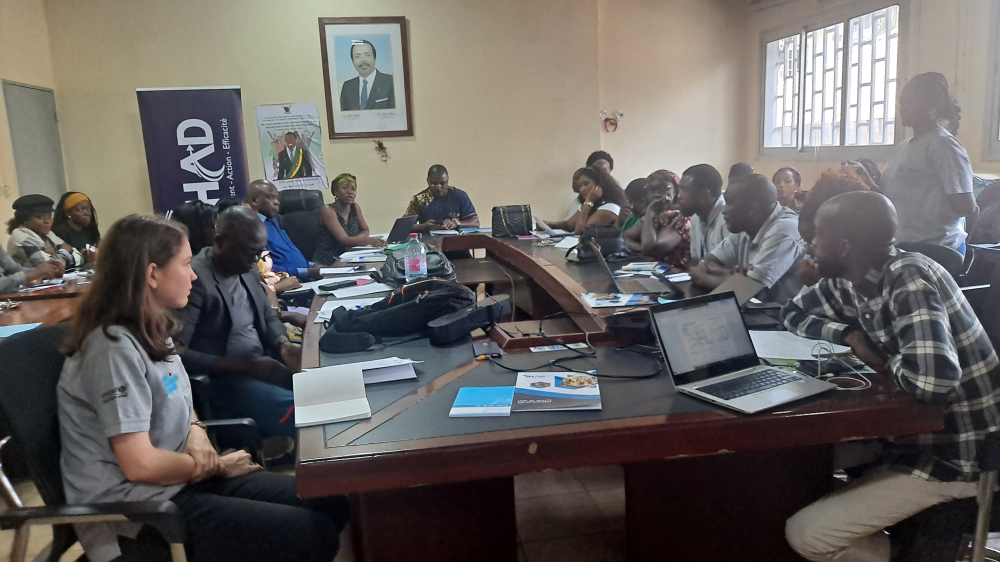
The Centre Regional Unit of the Expanded Programme on Immunization, EPI, field officials from three health districts in Mfoundi Division, and the Seed of Health And Development, SHAD evaluated the HCD project in Yaounde on February 27, 2026.
The air in the conference hall in Yaounde was thick with a mix of exhaustion and exhilaration. It was February 27, 2026, a date that marked not just the end of a project cycle, but the culmination of a radical experiment in public health. Authorities from the Centre Regional Unit of the Expanded Programme on Immunization, EPI, field officials from three critical health districts in the Mfoundi Division, and the implementation team from the Seed of Health And Development, SHAD had gathered. Their agenda was deceptively simple: to evaluate the past seven months of the “Human-centred Design, HCD: Improving the use of immunization services and promoting good nutrition practices” project.
Reversing The Trend
But beneath the PowerPoint presentations and the statistical breakdowns lay a deeper story. It was a story about moving beyond the rigid, top-down structures of traditional healthcare delivery. It was a story about sitting down with mothers in Nlongkak, speaking with fathers in Mokolo, and listening to adolescents in Mimboman. It was, ultimately, a story about placing the human being back at the centre of health.
As the meeting commenced, the data on the screen spoke of success: 387 zero-dose children caught up, 1,852 children supplemented with Vitamin A, and 241 adolescents vaccinated against the Human Papillomavirus (HPV). Yet, for Dr. Brice Edzoa Essomba, the Centre Regional Coordinator of the EPI, these numbers represented something far more profound than mere metrics. They represented a breach in the wall of distrust that has long hampered public health efforts in the region.
A Paradox Of Proximity
To understand the significance of this achievement, one must understand the geography of the problem. The project focused on three specific health areas: Nlongkak within the Djoungolo Health District, Mokolo in the Cité Verte Health District, and Mimboman in the Nkolndongo Health District.
These are not remote, inaccessible villages tucked away in the dense rainforests of the Congo Basin. They are urban and peri-urban zones, right in the heart of Cameroon’s capital. Paradoxically, it is often in these dense population centers that vaccination coverage falters. Unlike rural areas where the challenge is often logistical - the distance to the clinic or the lack of a health facility - the barriers in Mfoundi were psychological, social, and behavioural.
Lack Of Utilization
Low performance in these districts was not driven by a lack of infrastructure, but by a lack of utilization. The health centers were there; the vaccines were in the fridges; but the people were not coming. The main objective of the HCD project was therefore diagnostic in nature: to identify the invisible behavioral barriers and the rigid social norms that hinder access to these services. The goal was to transform these obstacles into levers for change.
This is where the Human-Centered Design, HCD approach came into play. Traditional public healthcare often operates on a "supply-side" logic: if you build it, they will come. HCD operates on a "demand-side" logic: understand why they aren't coming, and design the solution with them, not just for them.
A Participatory Revolution
The implementation of the project was a masterclass in participatory development. SHAD, working with funding from the United Nations Children’s Fund, UNICEF, did not simply march into these communities with posters and megaphones. Instead, they embarked on a process of co-creation.
The journey began with a rapid diagnostic survey. This wasn't just about counting heads; it was about generating evidence on the ground. What were the mothers saying? What rumors were circulating in the marketplaces? What were the traditional healers advising?
The Power Of Advocacy, Information
Armed with this evidence, the team moved to advocacy and information provision. Crucially, this wasn't limited to health authorities. They engaged community leaders - the religious figures, the neighborhood chiefs, the influential matriarchs whose blessing could make or break a health initiative.
The heart of the intervention lay in the co-creation and prototyping workshops. In these sessions, the hierarchy dissolved. Health workers sat with community members to sketch out solutions. If a mother said she couldn't come to the clinic because it was closed when she finished her trade, the solution wasn't to scold her; it was to prototype a temporary vaccination session that fit her schedule. If a father feared the vaccine was a plot to sterilize his child, the solution wasn't a lecture on virology; it was a dialogue led by a trusted neighbor.
Community Activities That Paid Off
This led to the implementation of community activities that felt organic rather than imposed. Community dialogues and interpersonal communication sessions replaced sterile announcements. Educational talks were held in local dialects and familiar settings. The organization of fixed and temporary vaccination sessions was timed to the rhythms of local life, not the administrative clock of the hospital.
Furthermore, the project embraced the digital age. The collection of feedback and the enrollment of community members on the Internet of Good Things, IoGT platform represented a bridge between traditional community work and the digital future. The IoGT platform, developed by UNICEF, became a tool for empowerment, allowing parents to educate themselves, bypassing the fog of misinformation that often clouds social media.
By The Numbers
The results provided a tangible validation of the HCD approach. The most staggering statistic was the catch-up of 387 zero-dose children. In public health terminology, a "zero-dose child" is a child who has received no vaccinations whatsoever. These are the most vulnerable children, the ones most likely to succumb to preventable diseases like measles or polio. Finding these children in dense urban environments is like finding a needle in a haystack. Bringing them into the fold of the health system is a victory for public health surveillance and community trust.
Beyond the zero-dose children, the project made significant inroads in nutrition. 1,852 children were supplemented with Vitamin A, a critical nutrient for immune health and vision. In a region where dietary diversity can be a challenge due to economic factors, this supplementation acts as a vital shield.
New Life, Adolescence
The project also addressed the specific needs of new life and adolescence. 347 mothers were supported in the early initiation of breastfeeding, a practice that is the "first vaccine" a child receives, providing colostrum rich in antibodies. Simultaneously, 114 adolescents were supplemented with Iron and Folic Acid (FeFol), addressing anemia that can hamper development and academic performance.
Perhaps one of the most forward-looking achievements was the vaccination of 241 adolescents against HPV. Cervical cancer is a leading cause of cancer death among women in Cameroon, and the HPV vaccine is a powerful preventative tool. Vaccinating adolescents requires a different level of engagement than vaccinating infants; it requires convincing the parents of pre-teens and teenagers, a demographic often harder to reach with standard health messaging.
A Plea For Consistency
While the statistics painted a picture of success, it was the "Voice of the Community" segment of the report that grounded the project in emotional reality. One parent from the Cité Verte Health District encapsulated the fragile nature of this trust. "We are very happy that our children received the deworming medication," the parent said, echoing the relief of many. But the statement continued with a request that serves as both a compliment and a warning: "and to ensure no children are missed, I would like the deworming medication to always be in stock in the health centre."
This statement highlights the tenuous link between the community and the health system. A single stock-out - a day when a mother walks to the center and finds the shelves bare - can undo months of trust-building. It reinforces the idea that HCD is not just about communication; it is about the reliability of the entire health system. The community is ready to engage, but the system must be ready to receive them.
Validation And Vision
Dr. Brice Edzoa Essomba, speaking at the restitution, offered a comprehensive validation of SHAD’s work. "We just completed the restitution of the project... in support of the reinforcement of routine vaccination and nutrition activities in the Centre Region," he stated.
He noted that the project, implemented by SHAD with UNICEF funding, had been monitored for over six months across the targeted districts of Djoungolo, Nkolndongo, and Cité Verte. Dr. Essomba was particularly pleased with the focus on the "catch-up of zero-dose children" and the emphasis on anti-HPV vaccination.
Replication, Expansion Requested
"What we proposed to SHAD is essentially to renew this experience for the new project cycle - if they have new grants," Dr. Essomba announced. This endorsement from the Regional Coordinator is significant. It signals a shift in regional policy towards more behavioral and social interventions. He recommended extending the interventions to other health areas with "essential adjustments" to further improve results.
Owono Fouda Lazare, the Coordinator of the HCD project at SHAD, delved into the technical recommendations that will guide the future. His comments highlighted the critical intersection of data and community.
Recommendations That Make The Difference
"The recommendations are of capital relevance to SHAD," Lazare explained. "First, that our findings be included in the DHIS, the platform of the Ministry of Public Health where data from all health districts is centralized."
This is a crucial step toward sustainability. HCD interventions often exist as "islands" of data - great stories told in a report but lost in the national health information system. By integrating these findings into the District Health Information Software, DHIS2, SHAD ensures that the behavioral insights gained are not lost, but become part of the permanent health record.
Lazare also emphasized the need for structural advocacy. "If we integrate Parents Teachers Associations, PTAs to obtain their commitment to the vaccination of their children, we will have gained something," he noted regarding the HPV vaccine target. Recognizing that schools are the primary hubs for adolescents, bringing PTAs into the loop creates a system of accountability and support that extends beyond the clinic walls.
Navigating The Minefield Of Misinformation
Despite the successes, the evaluation meeting was not a blind celebration. The "Major Challenges To Address" segment of the report laid bare the difficult road ahead. The primary challenge is the battle for the truth. "Maintaining the link with the community to continuously manage false information and rumors regarding health issues" was identified as paramount. In an era of WhatsApp rumors and distrust of authority, a one-time workshop is not enough. The fight against misinformation is a continuous game of whack-a-mole that requires constant vigilance and a persistent presence in the community.
Logistics, Funding
The second major challenge is logistical and financial: "The provision of nutrition inputs to achieve set objectives (outside EPI targets)." While the EPI (Expanded Programme on Immuniz...
Cet article complet est réservé aux abonnés
Déjà abonné ? Identifiez-vous >
Accédez en illimité à Cameroon Tribune Digital à partir de 26250 FCFA
Je M'abonne1 minute suffit pour vous abonner à Cameroon Tribune Digital !

- Votre numéro spécial cameroon-tribune en version numérique
- Des encarts
- Des appels d'offres exclusives
- D'avant-première (accès 24h avant la publication)
- Des éditions consultables sur tous supports (smartphone, tablettes, PC)


Reactions
De la meme catégorie

Affaire Martinez Zogo: Le 36e témoin entre en scène
- 27 Oct 2026 10:04
- 0 likes
Cameroon Medical Council: Newly Elected Pledges to Restore Dignity
- 27 Oct 2026 10:03
- 0 likes





Commentaires