

From Roundtable To The Streets: Cameroon Mobilizes For Equitable Justice On Women’s Day
- Par Kimeng Hilton
- 05 Mar 2026 15:00
- 0 Likes
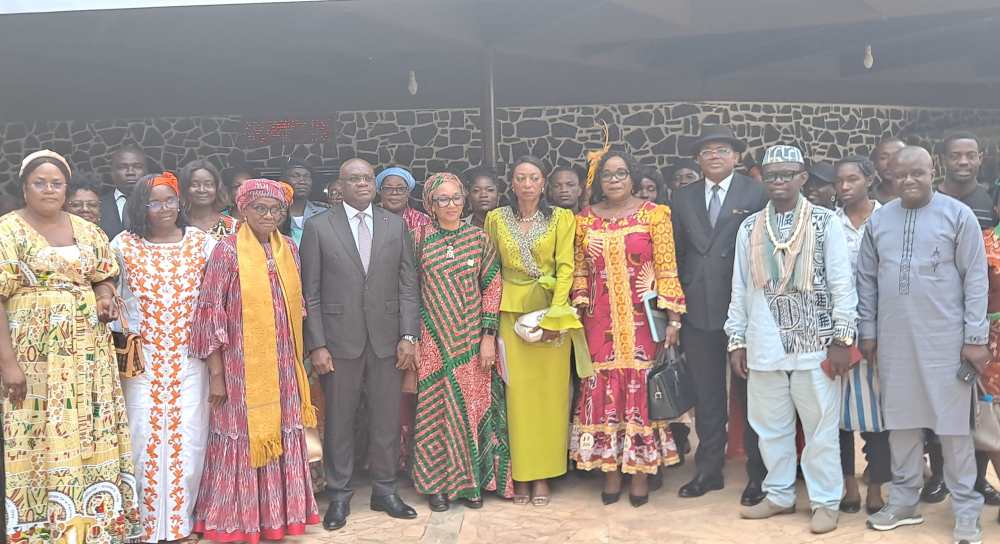
The Ministry of Women’s Empowerment and the Family, UN Women and the University of Yaounde I held a discussion in Yaounde on March 4, 2026. On UN Security Council Resolution 1325.
Under the humid equatorial sun of Yaounde, the air in the University of Yaounde I on March 4, 2026, was thick with more than just the heat. It was heavy with the weight of history and the urgency of the future. Inside the university campus, a roundtable discussion had convened, bringing together the highest echelons of international diplomacy, academia, and the security forces. The occasion was not merely a calendar event, but a critical checkpoint in a journey that began 25 years ago.
The topic was the implementation of United Nations Security Council Resolution 1325. But the conversation went far beyond the diplomatic corridors of New York. It drilled down into the red dust of Cameroon, the courtrooms of Yaounde, and the very lives of the female students sitting in the audience.
Unfinished Business
The gathering was a precursor to the global observance of International Women’s Day, set to be celebrated on March 8, 2026, on the theme: “Rights, justice, action, for all women and girls.” As the world enters the second quarter of the 21st Century, the stark reality is that legal equality remains an unfinished business. Globally, women benefit from only 64% of the rights recognized for men. At the current rate of progress, the United Nations warns it would take nearly three centuries to close these gaps. But in Yaounde, on this Tuesday March 4, 2026, there was a palpable refusal to wait three centuries.
Legacy Of Peacekeeping, Promise Of Protection
The hall fell silent as Prof. Marie-Thérèse Abena Ondoa, the Minister of Women’s Empowerment and the Family, took the stage. Her presence was a bridge between the policy of the capital and the reality on the ground. She spoke with the authority of a matriarch who has seen her nation’s daughters step into the breach.
Prof. Abena Ondoa painted a picture of Cameroonian women that defied the passive stereotype often ascribed to them. She spoke of women who have donned helmets and flak jackets, serving in peacekeeping roles in the neighbouring Central African Republic. She spoke of female journalists who have been trained not just to write the news, but to survive it, learning how to conduct themselves in the crucible of war.
Assuring Roles
“Women have been playing a great role in assuring peace in Cameroon and the world over,” she asserted, her voice resonating with the audience. She detailed the government’s legislative and structural efforts to strengthen the place of women in society, framing these not as favors to women, but as necessities for the nation’s stability.
Her address set the tone for the day: this was about acknowledging the contributions of women while simultaneously confronting the structural barriers that remain.
25 Years of Resolution 1325
Following the Minister, the microphone passed to Mrs. Marie-Pierre Raky Chaupin, the UN Women's Country Representative for Cameroon. She brought with her the gravitas of the United Nations and a stark reminder of the passage of time.
“It is already 25 years since the United Nations Security Council Resolution 1325 was adopted in 2000,” she began. For a quarter-century, the world has operated under the mandate that acknowledges the impact of war on women and the indisputable necessity of women's full and equal participation in conflict resolution, peacebuilding, peacekeeping, humanitarian response, and post-conflict reconstruction.
Beacons Of Hope In Often Dark World
Madam Chaupin offered a panoramic view of the global landscape. The numbers she cited were beacons of hope in an often dark world. In 2010, only 19 states had adopted plans for women; today, that number has surged to 113. Women are increasingly ascending to leadership positions, even in nations torn apart by conflict. Furthermore, the impunity that once shielded perpetrators of crimes against women is fracturing; crimes are increasingly being punished in societies across the globe.
“There is no durable peace without women,” she stated, a maxim that has become the heartbeat of the UN’s gender architecture. Yet, she did not shy away from the shadows. She referenced Resolution 113 on national plans and dropped a statistic that chilled the room: in 2024 alone, over 600 million women and girls lived under the shadow of deadly conflicts.
Mutating Challenges
The challenges, she noted, are mutating. Funding for women’s activities within the UN system is shrinking - a dangerous trend as the needs grow. In 2025, a quarter of the countries implementing the Beijing Plan of Action reported setbacks. Madam Chaupin argued passionately for a pivot from reaction to prevention, a transformation that must be rooted in data.
“Some 63% of global indicators are now sex-disaggregated,” she pointed out. This data, she explained, is the compass needed to prioritise, plan, and budget effectively. It turns anecdote into evidence. She described Resolution 1325 not as a dusty document of the past, but as a “promise of the future.”
Concluding her address, she turned to the students in the room, specifically those in the Professional Master's programme in Gender and Development. She invited them to make use of the rich library on gender issues at the UN Women's Country Office in Cameroon, symbolically handing them the keys to their own education and empowerment.
Peace In The Spirit
If the Minister spoke of the nation and the UN Representative spoke of the world, Prof. Rémy Magloire Dieudonné Etoua, the Rector of the University of Yaounde I, brought the discussion home. He spoke of the immediate environment of the students, the lecture halls, and the pathways they tread daily.
Prof. Etoua offered a philosophical take on security: “Peace only exists when it has been instilled in people’s spirits.” He argued that true security is not just the presence of guards, but the cultivation of a peaceful mindset. However, as the head of a major university, he was also a pragmatist.
Physical, Environmental Security
He detailed the specific actions his administration has taken to secure the campus. He spoke of rehabilitating green spaces, roads, and toilets - not merely as maintenance, but as the creation of a secure and dignified environment that reduces friction and promotes well-being. Lecture halls have been refurbished to facilitate good exchange, removing the physical barriers to communication.
Regarding physical security, the Rector was frank. The gendarmerie brigade and the police station in Ngoa-Ekelle, Yaounde are on standby. Police officers now keep guard all night long, a visible deterrent against the insecurity that plagues urban centers. Major entrances are monitored, and students are actively involved in these efforts, transforming them from passive recipients of security into active stakeholders.
Persistent Vulnerabilities
Yet, vulnerabilities remain. Prof. Etoua highlighted students as the most vulnerable demographic, particularly those with disabilities who face unique obstacles. He also touched upon health challenges, exacerbated by limited resources. Despite insurance for all students, the financial strain on the university health system is evident. His message was one of resilience: he urged the students to have confidence in themselves as the “youth builders” of tomorrow.
Justice, Silence Of The Home
As the conversation shifted from the campus to the courtroom, the tone grew somber. An Advocate General of the Supreme Court of Cameroon took the floor to discuss rendering justice to women. Her testimony stripped away the bureaucratic layers to reveal the raw human struggle for legal recourse.
She spoke of the immense difficulty women face in reporting abuse, particularly when the perpetrator is a member of their own family. “It is difficult to talk of gender-based violence in justice when it comes to femicides,” she noted. She drew a harrowing line: often, by the time violence reaches the courts, it has escalated beyond “gender-based violence” into murder or grievous bodily harm.
The legal system, she admitted, is not easily navigated by the poor. Hiring a lawyer is a luxury many women cannot afford. While the right to a fair hearing is guaranteed before all courts, the gap between the right to a lawyer and the means to hire one is where many women lose their battles.
Legislative Rethink
She called for a legislative evolution. Cameroon has ratified international conventions, she acknowledged, but ratification is not implementation. “The government needs to redefine, through particular legislation, certain offences concerning women,” she urged. New laws are needed to define specific crimes against women, closing the loopholes that allow abusers to hide behind archaic statutes. Her message was a call to arms for the judiciary: women must be encouraged to take their grievances to court, and the court must be accessible enough to receive them.
The Thin Blue Line And AI
The complexity of modern security was further unpacked by Police Commissioner Yahya Amadou of the National Judicial Police Headquarters, Yaounde. A PhD holder in Law, Commissioner Amadou represented the intersection of academic theory and street-level policing.
He spoke of Cameroon’s option for “popular defence,” emphasizing that citizens are not just bystanders but active players in proximity policing. He highlighted the presence of a Gender Focal Point within the police force and noted that women occupy senior positions, a testament to gradual progress.
Complex Security Environment
However, the Commissioner painted a picture of a nation under siege. He spoke of the “complex environment of recurrent risks,” citing the terrorist threat of Boko Haram in the Far North Region, as well as highway robberies and urban crime. The constraints he listed were familiar but daunting: finances, poor logistics, and a lack of specialization.
“Criminals are evolving their tactics,” he warned. “We need specialisation amongst police people.” He looked to the future, insisting on the adoption of Artificial Intelligence (AI) in fighting crime - a forward-looking stance that recognizes technology as the new frontier of law enforcement. He also stressed the need to promote more women to strategic security positions, breaking the glass ceiling within the police force.
Commissioner Amadou concluded with a profound statement that encapsulated the essence of the entire roundtable: “Lasting peace is not decreed, it is built through cooperation between citizens and security officials.”
Positive Masculinity
As the formal speeches concluded, Dr. Essomba Ebela Solange Rachel, a senior official of the University of Yaounde I, synthesized the day’s learning. Her summary shifted the focus from the problems to the solutions.
“What we learnt is that women no longer have to suffer in silence,” she declared. She pointed to the creation of help lines by the Ministry of Women’s Empowerment and the Family as tangible tools for this refusal to suffer. But perhaps her most poignant point was the concept of “positive masculinity.”
Citing an initiative of the Heads of State of the African Union, Dr. Essomba explained that this initiative consists of “holding women by the hand so that they progress together.” It is a partnership model designed to avoid the discrimination and inequalities that spark conflict. It acknowledges that the liberation of women is not a battle against men, but a journey toward mutual progress.
Multiple Causes
In a brief interview following the synthesis, the discussion turned to the darker side of the gender gap: femicide. “The causes are multiple,” Dr. Essomba explained. “There is poverty, lack of education… when children are educated by violent parents, they also become violent.”
When asked about measures at the university to eradicate this scourge, she offered a cautious optimism. “Among students, apart from the case denounced in Ebolowa recently, I don’t think we have recorded any case in the University of Yaounde I.” Yet, the challenge remains, particu...
Cet article complet est réservé aux abonnés
Déjà abonné ? Identifiez-vous >
Accédez en illimité à Cameroon Tribune Digital à partir de 26250 FCFA
Je M'abonne1 minute suffit pour vous abonner à Cameroon Tribune Digital !

- Votre numéro spécial cameroon-tribune en version numérique
- Des encarts
- Des appels d'offres exclusives
- D'avant-première (accès 24h avant la publication)
- Des éditions consultables sur tous supports (smartphone, tablettes, PC)


Reactions
De la meme catégorie

Affaire Martinez Zogo: Le 36e témoin entre en scène
- 27 Oct 2026 10:04
- 0 likes
Cameroon Medical Council: Newly Elected Pledges to Restore Dignity
- 27 Oct 2026 10:03
- 0 likes




Commentaires