

Interview: “I've Worked Hard And Paved The Way For Other Women”
- Par Kimeng Hilton
- 13 May 2026 13:05
- 0 Likes
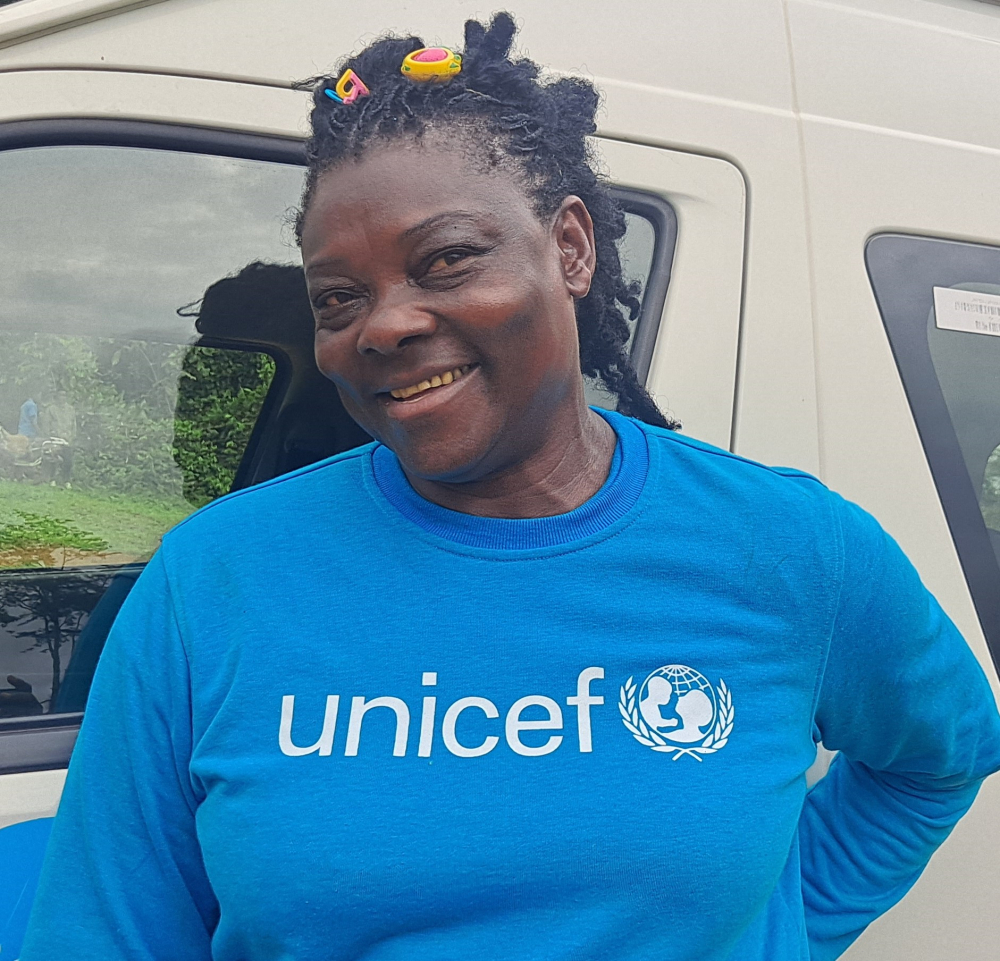
Louise-Francoise Ntoutou, 56, the first ever female professional driver with the United Nations System in Cameroon.
Who is Louise-Francoise Ntoutou?
I am 56 years old and I am the first female professional driver to be recruited by the United Nations System in Cameroon. I serve with the United Nations Children’s Fund, UNICEF, Cameroon
I started with UNICEF in May 2009. It's almost 16 years now. But I had been a professional driver since 2003. I began in bus companies.
After driving school?
My late husband, Mario Niber Lucas Sartorio, a man from Uruguay, taught how to drive. Then, I completed the training in driving school. I began by driving my own cars to run my errands like any woman (my late husband, who was a logger, bought three cars for me). I only started driving public transport vehicles in 2003 after losing my husband a year earlier.
Where did you start?
I started with Buca Voyages bus company. I did Yaounde-Ebolowa line. I drove 30 seats, Toyota Coasters or 35 seat-buses. I was with Buca Voyages for four months and moved on to RIM Voyages bus company. I was with RIM for about two or three years. Then I moved to JACO Voyages bus company where I plied Yaounde-Douala, Douala-Kribi, Kribi-Edea, Douala-Bafang-Bafoussam... I was with JACO for three years.
And after that?
In 2006 I applied to the newly created Le Bus bus company that did mass transit in Yaounde. They needed 150 workers, including drivers, who were to undergo training to get used to the logistics that were to come. Because the buses were long - 11 metres by 2.5 metres wide - which had to do urban mass transit. The 150 people were recruited and I was the best amongst the drivers.
Le Bus bus company later created Le Car bus company, which had its headquarters in Omnisports, Yaounde. We plied Yaounde-Douala and Yaounde-Bamenda routes only during the day. I was amongst the first set of workers detached to Le Car by Le Bus. I was there for three years before joining the United Nations Children’s Fund, UNICEF in 2009.
Did you go through a long interview process to be hired by UNICEF? Tell us how it went after you applied online.
No, at the time, they were applying by submitting physical papers. It became online after. UNICEF advertised the position in the newspaper and I saw and applied.
And you were called for interview?
They didn't call me right away. I was still working at Le Car. Unknown to me - like I was later informed - UNICEF, after receiving my application, secretly sent people to watch how I was driving with Le Car. This took quite some time, about a year!
Sometimes they will send an informant to travel with me as a passenger to Douala or Bamenda - just to watch how I conducted myself, treated passengers... After being satisfied with my work, UNICEF then invited me for interview/tests, and I was retained.
An aside… are they soldiers in your family? (looking at her straight in the face)
My father was a gendarme. I am the daughter of a gendarme.
Because when I look at you, I see a soldier in your physique. I don't see an ordinary woman.
No, I am the daughter of a gendarme. I was born in Edea. My father, a Bulu man from Ebolowa in the South Region, was the Gendarmerie Brigade Commander in Edea in the late 1960s.
He met my mother, a Bassa, in Makondo village 9km from Edea. He had come to the village to carry out an investigation during the UPC armed uprising, and the only person who spoke some French and could interpret for him from Bassa was my mother. That is how they knew each other and eventually fell in love to get married.
You chose marriage over enlistment into the military. How did you your father, as a former gendarme, react?
He was so angry and disappointed with me. He was not happy.
Did he live to see you working with the UN and earning a big salary?
By the grace of God, he was there. He actually died in my hands in 2019 after I had taken good care of him.
Before his death, had he changed his mind about being disappointed with you for not becoming a soldier like he was?
He was so contented with my UN recruitment. He no longer bore the regrets of the past. I am the first child and we are seven from our mother. But our mother had two other children before meeting and getting married to our mother.
My father later left the Gendarmerie and served as Stores Account with councils. He began in Mfou in Mefou and Afamba Division, then Akonolinga in Nyong and Mfoumou Division – all in the Centre Region. Before being transferred to Bazou in Nde Division of the West Region and finally retired in Ebolowa in the South Region at the age of 50 during the Public Service layoffs of 1994-1996.
Now, let’s go back to your recruitment by UNICEF. Where you the first female driver UNICEF recruited?
Yes, I was the very first female driver to be hired by UNICEF Cameroon, and by the United Nations System in Cameroon. That was in 2009. I think I served for almost 12 years before another female driver was recruited in the UN System in Cameroon. She was recruited by the United Nations Office for the Coordination of Humanitarian Affairs, OCHA.
I was the only female driver in the UN System in Cameroon for 12 years and had to prove myself. That's how I opened the door for other female drivers. Coincidentally, the lady driver recruited by OCHA was a former colleague of mine when I drove public transport buses. She is thus very experienced.
In UNICEF Cameroon, I was the only female driver until 2025 when they hired another lady and posted her to the office in Douala. So, for now, we are just two female drivers in UNICEF Cameroon.
Please tell us, during all these years with UNICEF, have you not been a curiosity as a female driver?
My presence has always moved many people. Everywhere I go, everyone is interested in my way of working. I work conveniently, well. And knowing that it is a woman who drives, has increased the curiosity.
You have been interviewed a number of times before…
Yes, I have been interviewed several times by the Cameroonian media - Cameroon Tribune, Le Messager… I even did a lot of tours with the journalist Baba Wame, formerly of CRTV. He was with three special envoys from France. My sisters in London later watched the documentary and called with a lot of excitement to inform me.
Tell us, what brought you into public transport driving? What led you to become a driver?
I wasn't prepared for it. I wasn't prepared at all.
What happened?
Driving is a gift. A spirit told me, go do it and I went ahead. I did technical training. I am a stenographer by training. I could have ended up as an Administrative Secretary.
I enlisted into the military, but did not finally go for training. By the time they called us for training, I had already met my husband, a Uruguay national who was a logger/forest exploitation. He didn’t want me to join the military and I respected his will. Maybe I would have become a soldier if the military didn’t take time to call us up for training. While waiting at home in Ebolowa for call-up, I met my husband and my destiny changed. But after my husband died at 53 years on December 15, 2002, I had to fend for myself and applied to drive public transport vehicles.
My husband was a very experienced hydro dam technician. He came to Cameroon in the late 1970s during the construction of the Songloulou plant in Edea. He was in charge of repairing heavy-duty machinery. He later turned to forest exploitation and died as a logging merchant.
Did you have children with him?
No, I didn’t.
After his death, you remained single?
Yes, I remained unmarried. Stigmatized, it's not easy.
Apart from trying to join the military, what else were you doing at the time?
I was also a good sports lady. I did high jump and played handball. I qualified to go for the All-Africa Games in Kenya in 1987, but couldn’t go because my parents couldn’t raise the money to prepare my papers.
I was a great handball player. We played against FAP (Forces Armées et Police) and against TKC (Tonnerre Kalara Club) in Yaounde. My club was at Djoungolo in Yaounde. Our handball court was at the former City Hall. There was a court there, but it’s all been developed now, they’ve torn everything down. That’s where we had our karate mats and everything. I’ve done a several sports.
What became of some of the ladies who were retained for enlistment into the military with you?
I was in Yaounde when I applied to join the military in 1990. The process went through successfully, but we were asked to return to our provinces of origin from where we were to be called up for training. But the call-up took long to happen – about 8 months after. By the time we were called up for training, I was already married! And some of the other ladies were already pregnant or also married and couldn’t go for military training! But some joined the military.
Do you still meet some of those who joined the military at the time you missed out?
Oh yes! I meet them. Most are now retired after attaining the ranks of Warrant Officers. I had applied to do parachute, but destiny had another plan for me.
Most of these former “colleagues” are surprised to hear that I still have about 10 years to go to retirement at 65 years. Meanwhile, they had long retired! (says so laughing)
Financially, you are better off working with United Nations than if you had joined the military.
Yes, I am by far better off (says so smiling).
What do you think of women and professional driving?
Well, it's not an easy job. Because when I look at my early beginnings and my achievements until now… For a woman to be a driver is not easy. She has to put together a number of things. For example, she has to be free.
She also has to love her job. Because if she's not free and she has a partner, or she's in a relationship and her partner doesn't allow her to work, she won't be able to do it. If she has little children or if she's still giving birth, I don't know how many employers will accept that.
You see the challenges of an old woman being a driver? So it's not easy at all. For a woman to be a professional driver, she must be of a certain age, be free, mature, really love her job and have autonomy.
Autonomy in what sense?
Autonomy in this case means the ability to impose herself. First of all, men are too jealous. They don't even allow you to do your work. I had to be really brave to stay in this job.
Men are too jealous. If you don't show your goodwill and are hardworking - as they say, work twice as much as men so that you are given your place – you will soon lose your driving job.
If you are confirmed in your professional driving job as a lady, you must work three times harder than men to keep the job.
You were secretly monitored for about a year before being recruited by UNICEF!
Those who recruited me had big hearts. They said, she wanted to work, we’ll take her.
You see, UNICEF took a big risk. When someone takes such a big risk, you really have to prove your worth. Because after recruiting a woman who can't really get to the expected level of work, it's a loss.
But I held on, and that's what I've done so far. If today UNICEF Cameroon still recruits women drivers, it is because I held on until now. My hard work and staying on has paved the way for more female drivers to be recruited in the United Nations Sys...
Cet article complet est réservé aux abonnés
Déjà abonné ? Identifiez-vous >
Accédez en illimité à Cameroon Tribune Digital à partir de 26250 FCFA
Je M'abonne1 minute suffit pour vous abonner à Cameroon Tribune Digital !
- Votre numéro spécial cameroon-tribune en version numérique
- Des encarts
- Des appels d'offres exclusives
- D'avant-première (accès 24h avant la publication)
- Des éditions consultables sur tous supports (smartphone, tablettes, PC)


Reactions
De la meme catégorie

Affaire Martinez Zogo: Le 36e témoin entre en scène
- 27 Oct 2026 10:04
- 0 likes
Cameroon Medical Council: Newly Elected Pledges to Restore Dignity
- 27 Oct 2026 10:03
- 0 likes




Commentaires