

Weaponized Words: Understanding The Digital Battle For Cameroon’s Social Fabric
- Par Kimeng Hilton
- 18 Jun 2026 21:51
- 0 Likes
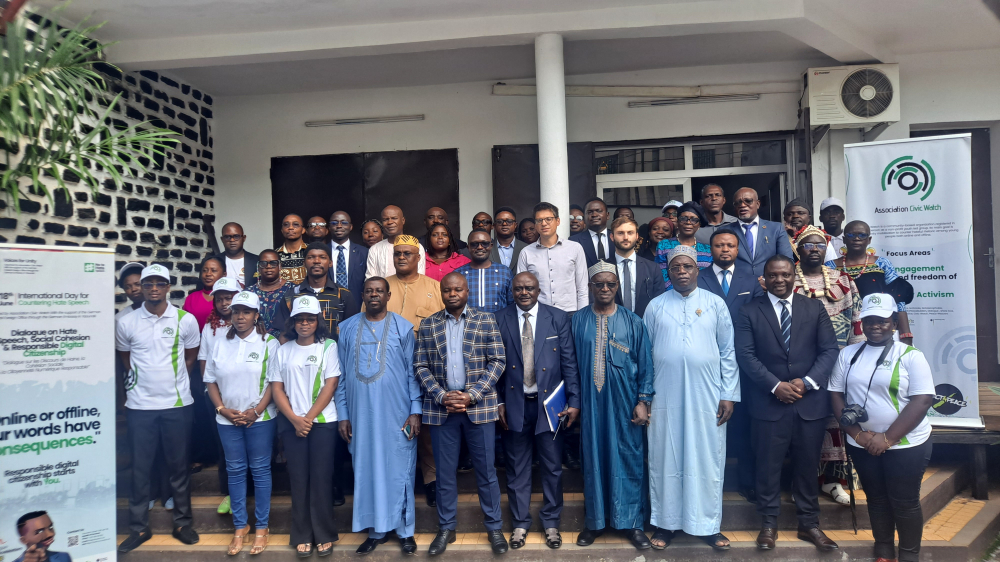
Civic Watch Cameroon Association on June 18, 2026 in Yaounde organized a stakeholders’ town hall meeting to mark the International Day for Countering Hate Speech.
Cameroon is grappling with a rapidly evolving information ecosystem where digital virality, structural socioeconomic grievances, and identity politics intersect. Meeting in Yaounde, Cameroon on June 18, 2026 to mark the International Day for Countering Hate Speech were civil society leaders, foreign diplomats, and legislators from conflict-affected regions. Their discussion was themed, “Dialogue on hate speech, social cohesion, and responsible digital citizenship."
Collectively, they issued an urgent warning. If left unchecked, the normalization of hate speech and coordinated disinformation will severely undermine national stability ahead of the 2027 municipal and legislative elections.
Digital Hate, Polarization
Dr. Ngala Desmond Ngala, the Chief Executive Officer, CEO of Civic Watch Cameroon association, organizers of the event, warned that hate speech has transitioned from fringe political rhetoric into a normalized, weaponized instrument across major digital platforms. Such as Facebook, WhatsApp, TikTok, and X. He observed that coded language, ethnic jokes, and casual stereotypes have steadily evolved into explicit hostility and calls for structural exclusion.
Anglophone Crisis, Violent Extremism
According to Dr. Ngala, this shift is acutely dangerous within Cameroon's current socio-political climate, where the unresolved Anglophone crisis and violent extremism in the Far North fuel competing narratives of victimhood. He emphasized that opportunistic influencers, political actors, and coordinated disinformation networks systematically exploit governance frustrations and economic hardships.
The Case Of Zoetele
Significantly, Dr. Ngala pointed to recent intercommunal clashes in Zoétélé as a real-world example of how unverified online rumors quickly materialize into physical violence. Looking ahead to the 2027 electoral cycle, he cautioned that the public sphere will become increasingly contested, requiring immediate investments in media literacy, independent fact-checking, and protection mechanisms for journalists and civic actors who face systematic digital harassment.
UN Perspective
Dr Stean Tshibanda Auguste, the United Nations Peace and Development Adviser to Cameroon affirmed that the normalization of identity-based slurs and derogatory terms occurs on a daily basis within the public domain. Often without dedicated institutional spaces for counter-dialogue. Grounding the conversation in global history, the representative reminded the assembly that mass atrocities and the darkest chapters of human history are routinely preceded by systemic dehumanization, stereotyping, and unchecked prejudice.
Unregulated Algorithms
In the digital age, this cycle is accelerated by unregulated algorithms and the integration of artificial intelligence. Dr Tshibanda noted that modern platform algorithms explicitly reward indignation, division, and falsehoods because they generate higher engagement, views, and "likes."
Implement UN Strategy
To counteract this algorithmic amplification, the United Nations official urged local stakeholders to implement the UN Strategy and Plan of Action on Hate Speech alongside the Global Principles for Information Integrity, stressing that freedom of expression must never be used as a pretext to legitimize incitement to violence or discrimination.
Grassroots Conflict Management
Hon. Agho Oliver Bamenju, MP, Tubah/Bafut Constituency, Mezam Division, North West Region, brought immediate operational context to the discussion by recalling the precise onset of the Anglophone crisis in Bamenda during the initial teachers' and lawyers' strikes. He detailed how a single unverified social media broadcast. Falsely claiming that the corporate consortium was being physically forced by government actors to sign a fraudulent agreement - instantly overthrew delicate field negotiations and set the entire town ablaze.
Serve Whole Villages!
Hon. Bamenju underscored that within rural communities, a single internet-connected television or smartphone often serves an entire village, meaning that interpretations provided by local youth to elders can instantly shape collective community behavior.
He argued that while Parliament has successfully established robust statutory frameworks - including the 2019 Law to Counter Hate Speech, revisions to the Penal Code, and specific online child protection and cybersecurity acts - the primary obstacle is the lack of coordinated, multi-stakeholder enforcement partnerships on the ground.
After Elections…
He emphasized that because Cameroon operates on a regular two-year electoral cycle (moving from the 2023 Senatorial elections, through the 2025 Presidential elections, to the upcoming 2027 Legislative and Council polls), political actors must change how they communicate, as political figures inevitably cycle out while communities must continue to coexist.
Cross-border Realities
Yaya Ndoumba Marius, MP and Traditional Ruler from Mbéré Division, Adamawa Region noted that domestic stability is directly connected to cross-border geopolitical realities. Drawing on his administrative experience managing the Borgop and Gado refugee camps, which currently host thousands of Central African Republic (CAR) citizens fleeing identity-driven political violence.
He issued a stern warning that if proactive early-warning mechanisms are not maintained, Cameroon risks transitioning from a regional sanctuary for displaced populations into a producer of outward-bound refugees seeking camp safety in neighboring Chad or Nigeria.
Perceived Absence Of Justice, Equity
From his dual perspective as a legislator and traditional chief, Marius asserted that the structural root of hate speech is fundamentally tied to the perceived absence of justice, equity, and balanced resource allocation on the ground. Within the Adamawa region, persistent conflicts between migratory herders and sedentary farmers are actively mitigated not merely by formal legislation, but through continuous, structured inter-community and inter-tribal dialogues that prioritize land-use equity.
Divisive Rhetoric
To systematically neutralize divisive rhetoric at its source, he proposed a baseline reform of national educational curricula to embed civic coexistence frameworks within early childhood development, alongside the mandatory mobilization of religious and traditional leaders to systematically integrate themes of structural tolerance and mutual respect into their weekly sermons and homilies.
Hon. Peter Njume, MP, Ndian Division, South West Region, delivered a direct critique of political and social elites, explicitly holding them responsible for the erosion of social cohesion across the national territory. Drawing from his personal experience, Hon. Njume stated that prior to the structural disruptions of 2016, Cameroonian communities lived in deep, unfragmented social alignment without the weaponized geographic slurs and exclusionary profiling that characterize contemporary public discourse.
"Irresponsible Digital Citizenship"
He argued that the current breakdown of social living is driven by "irresponsible digital citizenship" structurally engineered by elites seeking immediate political and personal gains. According to Hon. Njume, when influential figures appear on mainstream television and radio talk shows to broadcast divisive ethno-political narratives, common citizens accept those positions as absolute truths.
Blame The Elite
He concluded with a cautionary metaphor, warning that the elite have systematically nurtured a "snake" of tribal division for short-term leverage, and are now finding themselves forced to flee from the very forces they put in motion. He called for absolute accountability among public figures regarding the narratives they choose to amplify.
Unaware Of The Law
Honorable Awutah Phillip Atubah, Member of Parliament for the Momo West Constituency in the North West Region, issued a strong call to action regarding the rising tide of hate speech in Cameroon. Speaking at the same hate speech day event in Yaounde, the lawmaker emphasized that relying solely on the existence of laws is not enough to deter perpetrators of ethnic division.
Hon. Awutah highlighted the gap between the country's legal texts - such as Sections 113 and 241 of the Penal Code - and their implementation on the ground. He observed that while the preamble of the Constitution guarantees the right of all Cameroonians to settle and thrive anywhere within the national territory, very few citizens have actually read the text to understand their protections.
You Must Take Action!
"We think that laws enforce themselves," Hon. Awutah remarked, pointing out that courts cannot act unless victims themselves step forward to lodge formal complaints. He criticized the culture of overlooking severe offenses due to fear of social stigmatization, drawing parallels to how cases of child abuse and rape are frequently underreported.
The Momo West MP defined hate speech as “any discourse designed to arouse public violence, stigmatize communities, or make individuals feel inferior within society.” He warned that if left unchecked, ethnic polarization could deteriorate further. Referencing how the Anglophone Crisis escalated from neglected beginnings. He cautioned that failure to curb the scourge could potentially plunge the country into an outright civil war.
Raise More Awareness!
To break the cycle of impunity, Hon. Awutah called for nationwide sensitization tours to educate citizens on their constitutional rights - particularly regarding land tenure and peaceful coexistence. He stressed that only when individuals understand the law and test it in court, will legal precedents be set to correct current legislative lapses. Under existing laws, penalties for hate speech range from three to six months in prison alongside hefty fines. Which are doubled when targeted at a specific race or ethnic group.
Hon. Awutah concluded by thanking the organizers of the forum, urging that more of such grassroots meetings be replicated across the country to protect national unity. And foster a culture of legal redress.<...
Cet article complet est réservé aux abonnés
Déjà abonné ? Identifiez-vous >
Accédez en illimité à Cameroon Tribune Digital à partir de 26250 FCFA
Je M'abonne1 minute suffit pour vous abonner à Cameroon Tribune Digital !

- Votre numéro spécial cameroon-tribune en version numérique
- Des encarts
- Des appels d'offres exclusives
- D'avant-première (accès 24h avant la publication)
- Des éditions consultables sur tous supports (smartphone, tablettes, PC)


Reactions
De la meme catégorie

Affaire Martinez Zogo: Le 36e témoin entre en scène
- 27 Oct 2026 10:04
- 0 likes
Cameroon Medical Council: Newly Elected Pledges to Restore Dignity
- 27 Oct 2026 10:03
- 0 likes




Commentaires