
Awareness March : Activists Target Narcotics, Street Synthetics, Skin Bleaching
- Par Kimeng Hilton
- 10 Aug 2026 05:33
- 0 Likes
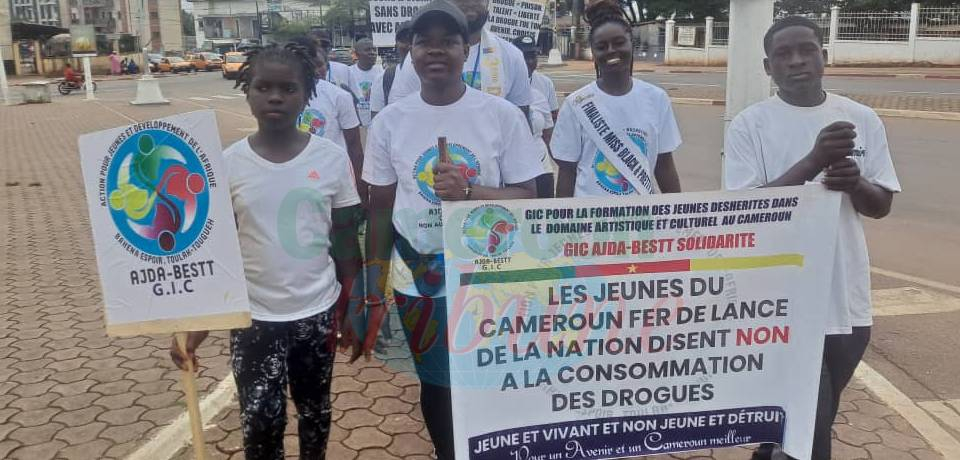
It was organized by the Common Initiative Group, GIC ADJA-BESTT Solidarité (Association d’Action pour Jeunes et Développement de l’Afrique).
On Saturday, August 8, 2026, scores of people gathered in some streets of the Cameroonian capital, Yaounde for an awareness march. Organized by the Common Initiative Group GIC ADJA-BESTT Solidarité (Association d’Action pour Jeunes et Développement de l’Afrique). In partnership with the Sports Association of Dynamic Youth (Association sportive des jeunes dynamiques, ASJD).
No To Narcotics, Skin Bleaching
Held as part of the official programme for the 11th International Youth Fair (SIJ 2026) and the International Youth Day on August 12, 2026, the march targeted two intersecting public health crises. Rising substance abuse and cosmetic skin bleaching among Cameroonian youth.
On the theme, "Cameroonian Youth, Say NO to the Consumption of Narcotics, Drugs, and Skin Bleaching," the event brought together grassroots civil society organizations, sports associations, community health advocates, and national beauty pageant titleholders. To deliver an urgent message on health, self-dignity, and civic responsibility.
Scope Of The Crisis
Sahock Djossi Youssa Djiaken Marcelle Délice (also known as Essam Marcelle Délice), President and Founder of GIC ADJA-BESTT, delivered a stark assessment of the situation on the ground. She noted that organizational observations indicate that roughly 72% of Cameroonian youth are directly or indirectly impacted by drug consumption.
"Drug consumption has been steadily rising across Cameroon, and no segment of society is spared," Delice emphasized. "Whether it is artists, medical personnel, law enforcement officers, university students, high school pupils, or business proprietors, every single layer of society is affected. If a young person is addicted, their coherence and productivity are destroyed. As the Head of State has affirmed, youth are the driving force of our nation. That is why we must focus our awareness efforts on protecting them," she added.
National Data On Drug Abuse
The urgency expressed by organizers aligns closely with official figures published by the National Anti-Drug Committee (Comité National de Lutte contre la Drogue, CNLDT) and recent epidemiological field surveys: National figures from the CNLDT indicate that approximately 21% of Cameroon's general population has consumed illicit or controlled substances at least once, with 10% classified as regular consumers.
Psychoactive Substances
Over 60% of all drug users in Cameroon are young adults aged 20 to 25. Furthermore, public health reports estimate that over 12,000 children under the age of 15 in Cameroon regularly use narcotics and psychotropic substances. Recent epidemiological studies conducted across major urban hubs - including Yaounde, Douala, and Buea - reveal that between 42.4% and 54% of secondary school students have experimented with or regularly consume psychoactive substances.
Aside from alcohol (which remains the primary gateway substance, consumed by upwards of 66% to 77% of youth in urban centers), cannabis accounts for 58.5% of illicit substance demand. It is closely followed by non-medical prescription opioids - principally Tramadol (44.6%) - alongside volatile solvents (7.4%), cocaine (12.1%), heroin (5.7%), and makeshift artisanal mixtures.
Popular Street Substances
Organizers drew explicit attention to the wide array of toxic substances circulating in local neighborhoods. These range from street-named concoctions such as la taille, le banga (cannabis), la tomate, and le caillou (crack cocaine), to pharmaceutical misuse involving Tramadol and Diazepam.
Activists warned that chronic consumption damages the central nervous system, leading directly to academic failure, school dropout, severe mental health disorders, social displacement, and increased criminal vulnerability.
Sensitization Strategy
The awareness walk commenced early in the morning at the Multipurpose Sports Complex (Palais des Sports) in Warda neighbourhood of Yaounde. Activists marched through major urban hubs and high-density commercial corridors, including Briqueterie, Mokolo Elobi, Nkomnkana, before assembling at Sous Prefecture Tsinga.
Route Encounters
Along the route, volunteers and association leaders engaged directly with pedestrians, traders, and residents. They distributed hundreds of educational pamphlets detailing the neurological, physical, and social hazards of drug addiction.
Conducted interactive street talks explaining the goals of the campaign and directing at-risk youth toward available support systems. And raised awareness on the dangers of cosmetic skin bleaching (dépigmentation de la peau).
Campaign Against Skin Bleaching
In addition to addressing chemical substance abuse, the march took a strong public stance against chemical skin bleaching. Participants displayed prominent banners with slogans such as "Our skin, our pride! Let's say NO to products that destroy us!" and "A conscious youth, a strong and prosperous Cameroon!"
Organizers highlighted the severe health hazards associated with topical bleaching agents (including hydroquinone, corticosteroids, and mercury compounds). Which cause irreversible stretch mark...
Cet article complet est réservé aux abonnés
Déjà abonné ? Identifiez-vous >
Accédez en illimité à Cameroon Tribune Digital à partir de 26250 FCFA
Je M'abonne1 minute suffit pour vous abonner à Cameroon Tribune Digital !

- Votre numéro spécial cameroon-tribune en version numérique
- Des encarts
- Des appels d'offres exclusives
- D'avant-première (accès 24h avant la publication)
- Des éditions consultables sur tous supports (smartphone, tablettes, PC)


Reactions
De la meme catégorie
Affaire Martinez Zogo: Le 36e témoin entre en scène
- 27 Oct 2026 10:04
- 0 likes
Cameroon Medical Council: Newly Elected Pledges to Restore Dignity
- 27 Oct 2026 10:03
- 0 likes





Commentaires