

On Their Marks, Set! Go! Standards, Infrastructure, Attendance, Lead School Reopening
- Par Kimeng Hilton
- 07 Sep 2026 15:37
- 0 Likes
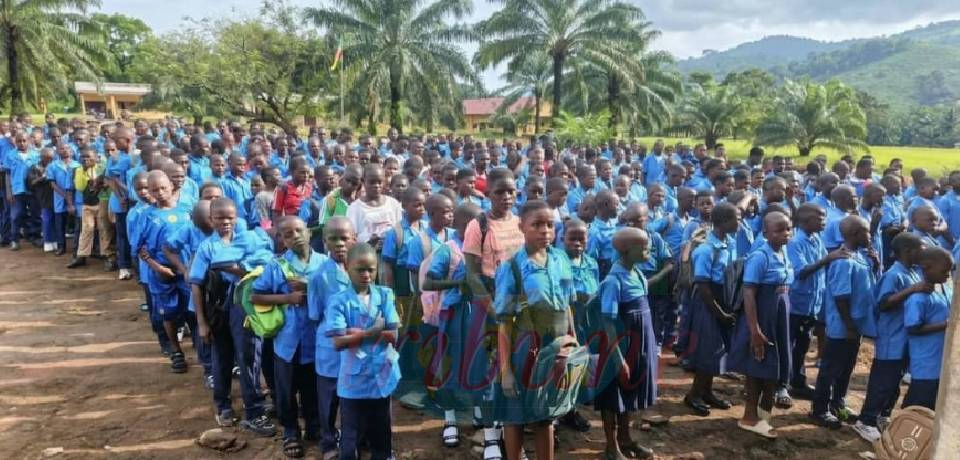
Authorities all over the country have been on ground since early September 7, 2026 to assure that the 2026/2027 school year has taken off in earnest.
As dawn broke across Cameroon on Monday, September 7, 2026, the familiar, rhythmic sound of brass bells and singing echoed through morning mists. From the coastal shores of Douala to the northern plains of Maroua. Hundreds of thousands of uniformed pupils and students filled the nation’s thoroughfares, marking the official kickoff of the 2026/2027 academic year.
High-stakes Oversight
Far from a quiet return to the chalkboard, the day was defined by high-stakes oversight. In line with state directives to ensure an effective, hitch-free takeoff, a massive deployment of cabinet ministers, regional governors, senior administrative authorities, and departmental inspectors, fanned out across the country to evaluate effective teaching on day one.
Ministers, Governors Take To The Field
In the political capital, Yaounde, delegation vehicles set out long before the 7:30 a.m. assembly hour. The Minister of Secondary Education, Prof. Nalova Lyonga, and the Minister of Basic Education, Laurent Serge Etoundi Ngoa, led supervisory teams across several public and private institutions. To inspect classrooms, review timetable compliance, and enforce pedagogical standards.
Minister Nalova Lyonga addressed teachers and administrative staff gathered in various school courtyards, stressing that the effective start of school on day one is not an option; it is a national pedagogical imperative. “We are here today to observe that teaching has indeed commenced, that teachers are at their posts, and that our digital learning initiatives are operational in the classrooms from this very morning. A successful academic year is built on the discipline of the first hour," Minister Nalova emphasized.
Clear-cut Priorities
Minister Laurent Serge Etoundi Ngoa echoed this stance while inspecting primary campuses in the Centre Region. Emphasizing that funding and administrative mechanisms had been deployed well in advance to ensure schools were fully operational. "Our priority for 2026/2027 is clear: consolidating academic foundations and maintaining maximum coverage of our syllabi. From today, every child in every classroom must receive quality instruction. The State has played its part, and we expect educators and parents to play theirs," Prof. Etoundi Ngoa insisted.
Across The Regions
Across the country's administrative headquarters, local authorities maintained the same rigorous presence.
Donga-Mantung Division
Classrooms across Donga-Mantung Division in the North West Region officially reopened on Monday, September 7, 2026, marking a resilient resumption of academic activities for the 2026/2027 school year. Official statistics compiled by the Divisional Delegate for Secondary Education, Mr. Tarlishi Oliver Yinyu, reveal an encouraging start. With thousands of students and teachers returning to school grounds across the division’s five subdivisions on day one.
Turnout Of 47.23%
Overall figures show that out of an expected population of 16,523 students across secondary and technical institutions in the division, 7,804 pupils - comprising 4,026 boys and 3,778 girls - effectively attended classes on opening day, representing an overall student turnout rate of 47.23%. Observers say this is quite encouraging, given that the division – like the rest of the region – is currently facing disruptions to school activities.
Administrative and teaching staff led by example, recording high attendance rates of 79.65% (90 out of 113 expected administrators present). And 66.79% (175 out of 262 expected teachers present) respectively. Pedagogical activities took off immediately as teachers executed 1,028 lessons out of the 1,572 programmed for the day, achieving a 65.39% lesson coverage rate.
Nkambe Central Leads
A closer look at the subdivisional breakdown highlights Nkambe Central as the primary driver of day-one turnout. Out of 8,459 expected students in Nkambe, 5,983 were present in class. High turnout was particularly recorded at institutions such as GTHS Nkambe, which registered 3,334 students present (111.13% of its initial estimate). St. Rita Nkambe with 533 students present (106.6%), and GBHS Nkambe (English section) with 685 students present (52.69%). Teachers in Nkambe Central executed 710 out of 897 scheduled lessons, achieving a robust 79.15% instruction delivery rate.
Ako Subdivision
In Ako Subdivision, 751 students out of 1,367 expected turned out across reporting schools, yielding a 54.94% attendance rate. Leading the resumption in Ako were GTHS Ako (366 students present, 145.82%). And GBHS Ako (385 students present, 77%), supported by 10 administrative officials and 15 teachers who effectively delivered 116 out of 138 programmed lessons (84.06%). Misaje Subdivision also posted steady resumption figures, with 719 out of 1,650 expected students attending class (43.58%). Led by GBHS Misaje (273 students) and GTHS Misaje (203 students).
Nwa Subdivision
In Nwa Subdivision, 351 out of 2,256 expected students attended day-one classes (15.56%). With activities recorded across several institutions, including GTHS Nwa (124 students present), St. Theresia Sabon (79 students), GSS Dzembuck (78 students), and GHS Sabongari (50 students). Teachers in Nwa delivered 135 out of 297 programmed lessons (45.45%).
With administrative structures operational and pedagogical coverage underway across major hubs, educational authorities under Mr. Tarlishi Oliver Yinyu expect student attendance to surge throughout the remainder of the week. As momentum builds across Donga-Mantung Division.
Littoral, West Regions
In the Littoral Region, Governor Dieudonné Ivaha Diboua led an early morning motorcade to schools across the Douala metropolis. Verifying teacher attendance registers and checking sanitation facilities. Meanwhile, in the West Region, Governor Awa Fonka Augustine inspected institutions in Bafoussam, cautioning school heads against unauthorized fee levies. And demanding immediate compliance with the official 2026/2027 academic calendar.
Discipline, Tears, Fresh Chalk
Across the national territory, day one delivered its usual mixture of rigid discipline, heartwarming reunions, and emotional meltdowns. In Government Bilingual Primary School, GBPS Ebang 1 in the Mefou and Afamba Division of Centre Region, morning assembly was a study in contrasts. While older pupils in crisp blue-and-khaki uniforms stood straight as arrows to sing the National Anthem, “O Cameroon, Cradle of our Forefathers,” the nursery wing presented a livelier scene.
First-timers
First-time nursery toddlers engaged in loud, synchronized protests, clutching their parents' legs. One determined three-year-old at GBPS Ebang 1 managed to slip past a gatekeeper, clutching a bright blue lunchbox. Only to be scooped up by a smiling teacher who promised him a singing game if he joined the class.
Evening Schools Also
Meanwhile, at Hardford Evening School in Odza, Yaoundé, an older demographic prepared for their own fresh start. Alongside traditional classroom setups, administrative teams demonstrated their expanded hybrid and online learning portals, designed to assist working adults and GCE candidates balancing daytime jobs with evening studies.
Down To Practice!
In technical high schools in Douala and Yaoundé, the day’s directive was immediate practical engagement. Rather than holding mere administrative roll calls, teachers in carpentry, electrical engineering, and home economics had students write down course outlines. And take safety orientations before 9:00 a.m. Enforcing the government's push toward enhanced technical and vocational training for the 2026/2027 school year.
Vision For New Academic Year
The government’s visible presence on reopening day underscores broader systemic targets established for the 2026/2027 academic cycle. Following high examination pass rates in the previous cycle, the Ministries of Basic and Secondary Education are placing heightened emphasis on pedagogical innovation, inclusive education. And the integration of digital tools alongside traditional face-to-face instruction.
Set! Go!
As government delegations completed their field tours on Monday afternoon, the feedback was largely uniform: administrative machinery was running, teachers were at their chalkboards. And pupils were back at their desks. With the tone set by high-level field inspections on September 7, 2026, Cameroon's educational community now embarks on a 36-week journey toward academic success.
As dawn broke across Cameroon on Monday, September 7, 2026, the familiar, rhythmic sound of brass bells and singing echoed through morning mists. From the coastal shores of Douala to the northern plains of Maroua. Hundreds of thousands of uniformed pupils and students filled the nation’s thoroughfares, marking the official kickoff of the 2026/2027 academic year.
High-stakes Oversight
Far from a quiet return to the chalkboard, the day was defined by high-stakes oversight. In line with state directives to ensure an effective, hitch-free takeoff, a massive deployment of cabinet ministers, regional governors, senior administrative authorities, and departmental inspectors, fanned out across the country to evaluate effective teaching on day one.
Ministers, Governors Take To The Field
In the political capital, Yaounde, delegation vehicles set out long before the 7:30 a.m. assembly hour. The Minister of Secondary Education, Prof. Nalova Lyonga, and the Minister of Basic Education, Laurent Serge Etoundi Ngoa, led supervisory teams across several public and private institutions. To inspect classrooms, review timetable compliance, and enforce pedagogical standards.
Minister Nalova Lyonga addressed teachers and administrative staff gathered in various school courtyards, stressing that the effective start of school on day one is not an option; it is a national pedagogical imperative. “We are here today to observe that teaching has indeed commenced, that teachers are at their posts, and that our digital learning initiatives are operational in the classrooms from this very morning. A successful academic year is built on the discipline of the first hour," Minister Nalova emphasized.
Clear-cut Priorities
Minister Laurent Serge Etoundi Ngoa echoed this stance while inspecting primary campuses in the Centre Region. Emphasizing that funding and administrative mechanisms had been deployed well in advance to ensure schools were fully operational. "Our priority for 2026/2027 is clear: consolidating academic foundations and maintaining maximum coverage of our syllabi. From today, every child in every classroom must receive quality instruction. The State has played its part, and we expect educators and parents to play theirs," Prof. Etoundi Ngoa insisted.
Across The Regions
Across the country's administrative headquarters, local authorities maintained the same rigorous presence.
Donga-Mantung Division
Classrooms across Donga-Mantung Division in the North West Region officially reopened on Monday, September 7, 2026, marking a resilient resumption of academic activities for the 2026/2027 school year. Official statistics compiled by the Divisional Delegate for Secondary Education, Mr. Tarlishi Oliver Yinyu, reveal an encouraging start. With thousands of students and teachers returning to school grounds across the division’s five subdivisions on ...
Cet article complet est réservé aux abonnés
Déjà abonné ? Identifiez-vous >
Accédez en illimité à Cameroon Tribune Digital à partir de 26250 FCFA
Je M'abonne1 minute suffit pour vous abonner à Cameroon Tribune Digital !

- Votre numéro spécial cameroon-tribune en version numérique
- Des encarts
- Des appels d'offres exclusives
- D'avant-première (accès 24h avant la publication)
- Des éditions consultables sur tous supports (smartphone, tablettes, PC)


Reactions
De la meme catégorie

Affaire Martinez Zogo: Le 36e témoin entre en scène
- 27 Oct 2026 10:04
- 0 likes
Cameroon Medical Council: Newly Elected Pledges to Restore Dignity
- 27 Oct 2026 10:03
- 0 likes





Commentaires