

Beyond The Ramps And Braille: The Crusade To Unlock Ballot Box For The Visually-impaired
- Par Kimeng Hilton
- 12 Mar 2026 16:21
- 0 Likes
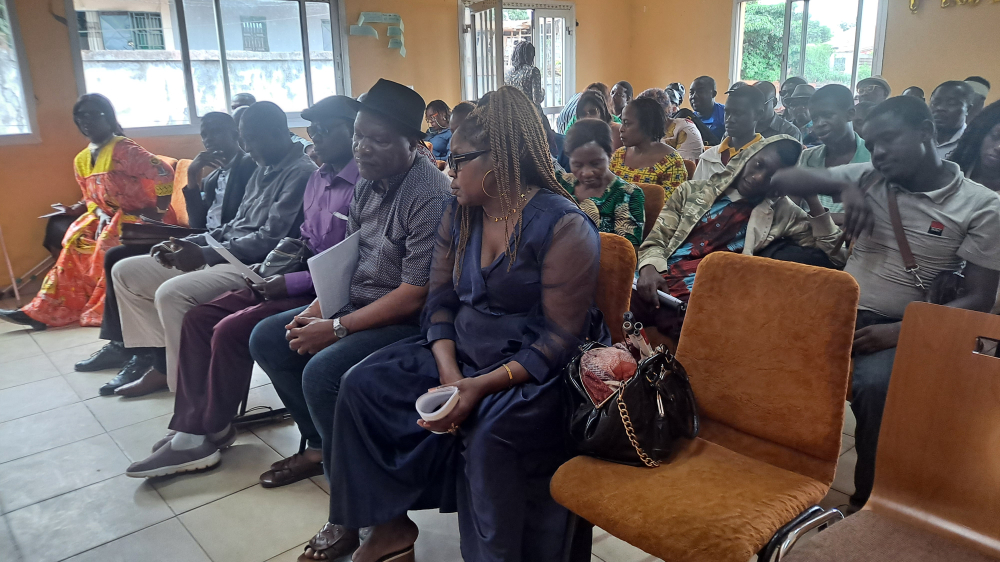
The “Club des Jeunes Aveugles Réhabilités du Cameroun,” CJARC held a workshop in Yaounde on March 12, 2026. To press home the demands of Persons With Disabilities in electoral processes and public life.
Inside the conference hall of “Club des Jeunes Aveugles Réhabilités du Cameroun,” (Club of Rehabilitated Blind Youth of Cameroon) CJARC in Ekié, Yaounde, the atmosphere was electric, charged with a palpable sense of urgency and history in the making. It was Thursday, March 12, 2026, a date that would likely not make the headlines of the mainstream news, but one that signaled a quiet, profound shift in the Cameroonian political landscape.
Gathered For Common Cause
Gathered here were 200 individuals - a diverse tapestry of civil society, government, ruling and opposition party officials, and, most importantly, the visually impaired citizens of Cameroon. They came with a singular, potent purpose: to challenge the very foundations of how democracy is practised in their country.
The workshop was not merely a meeting; it was a declaration of existence. On the theme, "Political participation of persons with disabilities: Issues, challenges, and strategies for the upcoming legislative and municipal elections," the walls of the CJARC centre echoed with a demand that has not been given appropriate consideration for too long: “Nothing about us, without us.”
With Forthcoming Elections In Mind
As the upcoming electoral deadlines loom on the horizon, bringing with them the usual flurry of political campaigning and strategizing, a stark reality remains. In a nation that prides itself on democratic evolution, a significant slice of the electorate is left in the shadows - quite literally. Social inclusion, the bedrock of a true democracy, remains a steep, often insurmountable mountain for Persons With Disabilities, PWDs. Despite the glossy brochures of legislative advancements, the daily lived experience of a blind or voter with disability in Cameroon is a gauntlet of physical barriers, communication gaps, and behavioral prejudices.
The workshop convened by CJARC was a direct response to this crisis. Leveraging years of experience in the trenches of advocacy, the organization mobilized key stakeholders to ensure that when the next votes are cast, no category of citizen is left behind. This is the story of the workshop, the people who drove it, and the movement they hope to ignite - to transform the electoral process from an obstacle course into a truly inclusive public square.
The Silent Statistics
To understand the weight of the gathering in Ekié, one must first confront the sobering mathematics of representation in Cameroon. The numbers are not just statistics; they are an indictment of the current political system.
Dr. Coco Bertin, the Director General of CJARC, spoke to the assembly, his voice steady but laced with a righteous indignation. He laid out the facts with surgical precision. Out of 180 parliamentarians currently sitting in the National Assembly, there is not a single person with a disability. In the Senate, the picture is equally bleak. Among 100 senators, zero have a disability. The only glimmer of representation is a single alternate senator - a position that often carries little legislative weight.
Same Story
The local government level tells a similar story of marginalization. Out of a staggering 10,569 councilors across the nation, only 14 are persons with disabilities.
"You see that with the number of people with disabilities in Cameroon - which is between 3.5 million and 4 million people - these figures can bring about discouragement and resignation," Luc Yomby from the PROMHANDICAM Association would later observe.
The contrast is jarring. PWDs represent approximately 16% of the Cameroonian population. If democracy were a mirror reflecting the society it serves, one would expect roughly 16% representation in elected institutions. Instead, the representation is statistically negligible, hovering near zero. This is the "16% Paradox." It is a demographic that constitutes a massive voting bloc, yet remains virtually invisible within the halls of power.
The participants in the Ekié workshop know these numbers by heart. They live them every day. They know that the barriers are not just architectural - though the lack of ramps and accessible polling stations is a glaring issue - but deeply systemic. The exclusion stems from a lack of trust, a failure of imagination, and a culture that views disability through the lens of charity rather than capability.
Why The Blind Are Left Behind
The workshop was structured to dismantle these barriers layer by layer, moving from the physical to the psychological. The methodology was clear and uncompromising: thematic presentations, intense workshop sessions, and a roundtable that facilitated direct dialogue between the marginalized and the gatekeepers.
Speaking to journalists after, Luc Yomby representing PROMHANDICAM Association, brought a sociologist’s eye to the problem. He explained that the absence of PWDs in politics is not an accident; it is a result of intersecting forces.
"People with disabilities are not often considered for elected political offices," Yomby noted, his voice cutting through the hum of the courtyard. "Added to this is their little knowledge of politics. Hardship has led many to focus on activities that generate income."
Attention Elsewhere
This point is crucial. For many Cameroonians living with disabilities, survival is the primary political act. In an economy where safety nets are frayed, the daily struggle to secure food, shelter, and healthcare often crowds out the luxury of political engagement. When you are navigating a world not built for you, simply getting to the end of the day is a victory.
But Yomby went further, highlighting a crisis of confidence. "People with disabilities are not yet aware of the importance of participating in politics and public life," he said. "And the problem also arises at another level, that of the non-realistic consideration of people with disabilities in decision-making."
Dr. Coco Bertin echoed this sentiment, framing it as a crisis of trust. "We noticed people with disabilities are still excluded from political parties, they are not trusted," he told the assembly. He painted a picture of tokenism, where people with disabilities are recruited to fill quotas or for photo opportunities, but are ignored when it comes time to draft lists of candidates for elections.
Self-perpetuating Exclusion
"Some people with disabilities in some political parties are ignored," Bertin continued, his frustration palpable. "So we wanted, on the one hand, to encourage people with disabilities to be active in political parties, and encouraged political parties to make room for people with disabilities."
This exclusion is self-perpetuating. When young people with disabilities look at the National Assembly and see no one who looks like them, no one who navigates the world as they do, the message is clear: You do not belong here. It breeds the exact discouragement Yomby spoke of. It turns a potential leader into a passive observer.
Beyond The Ramp
While the trust issues are complex, the physical barriers to voting are starkly practical. The workshop dedicated significant time to the "nitty-gritty" of electoral access - how does a blind person actually cast a secret ballot?
Mrs. Alice Tankam, Inspector No. 2 in charge of Electoral Procedures in the Ministry of Territorial Administration, MINAT, represented the government’s perspective. Her presence was significant, signaling that the State is at least listening. MINAT, as the oversight authority of the electoral process, literally holds the keys to the polling stations. "The role of MINAT is to ensure access to polling stations for people with disabilities," Mrs. Tankam stated. She acknowledged the challenges ahead, noting that MINAT wants to see participants access polling stations in the future with greater ease.
But "ease" is a high bar. For a visually impaired person, a standard polling station is a maze. The queues are difficult to navigate; the ballot papers are meaningless sheets of paper without Braille or tactile templates; the voting booths are often cramped and poorly lit for those with low vision.
Luc Yomby highlighted a breakthrough from the presidential election of October 2025 - as proof of the concept that things can change. "PROMHANDICAM sensitized visually impaired people on the use of the touch screen, an operational mechanism that enabled registered visually-impaired people to vote," he explained.
Game Changer
This technological intervention was a game-changer. It allowed for privacy and autonomy. No longer did a blind voter need to whisper their choice to a stranger, a relative, or an election officer, sacrificing the secrecy of the ballot. The touch screen pilot demonstrated that the technical solutions exist. The challenge now is scaling these solutions for the legislative and municipal elections.
The discussions in the workshop sessions delved into these specifics. Participants debated the need for Braille ballots, tactile guides, and the necessity of training polling station staff. They talked about the physical layout of voting centres - ramps for wheelchair users are vital, but so are clear auditory cues and safe pathways for the visually impaired.
The atmosphere in the breakout groups was one of collaborative problem-solving. Civil Society Organizations, CSOs and Organizations of Persons with Disabilities, OPDs brainstormed strategies for "inclusive electoral monitoring." They weren't just asking for the right to vote; they were demanding the right to watch the vote, to ensure that the process is fair and free.
A Roadmap For The Future
As the day progressed, the workshop moved from identifying problems to proposing solutions. The agenda was packed, moving from the opening ceremony - graced by the representative of the Mayor of Yaounde 4 Council - through a panel discussion on the "Accessibility of the electoral process in Cameroon," and into intense group work.
The climax of the event was the presentation of the "Roadmap for inclusive elections." This document, hot off the presses of the group discussions, is a blueprint for action. It is a formal commitment to change the status quo.
The expected results of the workshop were ambitious but necessary. First, to ensure that political decision-makers are sensitized to the specific needs of PWDs. This goes beyond justice (sympathy); it requires an understanding that a blind voter needs more than just a helpful hand - they need a system designed for independence.
Political Parties
Second, the workshop sought a formal commitment from political parties. This is perhaps the hardest nut to crack. Political parties are machines designed to win elections, and they often view candidates with disabilities as "risks." Changing this narrative requires direct engagement. The presence of both the ruling party and the opposition at the Ekié workshop was a strategic masterstroke by CJARC. It forced the parties to look their excluded constituents in the eye and hear their demands for representation on electoral lists.
Third, the dissemination of the voter guide for Persons With Disabilities. Knowledge is power, and knowing how to vote, where to vote, and what rights one has is the first step toward political agency.
Voices From The Frontlines
The emotional core of the...
Cet article complet est réservé aux abonnés
Déjà abonné ? Identifiez-vous >
Accédez en illimité à Cameroon Tribune Digital à partir de 26250 FCFA
Je M'abonne1 minute suffit pour vous abonner à Cameroon Tribune Digital !
- Votre numéro spécial cameroon-tribune en version numérique
- Des encarts
- Des appels d'offres exclusives
- D'avant-première (accès 24h avant la publication)
- Des éditions consultables sur tous supports (smartphone, tablettes, PC)


Reactions
De la meme catégorie
Dialogue communautaire: La force des mots
- 22 Oct 2026 19:47
- 0 likes


Commentaires